
As water moves through pipes and local infrastructure, it picks up particles or trace compounds along the way everything from chlorine used for disinfection to everyday organic molecules found in most cities. These variations are normal across North America and are part of why modern filtration technologies continue to evolve.
As water challenges have evolved, so has filtration technology. Activated carbon fiber filtration represents one of the most significant advancements in modern point of use water filtration. It builds on the same core principle that made carbon filtration the industry standard for decades adsorption but updates the engineering behind it to deliver faster, more consistent performance in today’s real-world water conditions.
Activated carbon fiber isn’t about replacing traditional carbon media. It’s about making the adsorption process more accessible, more efficient, and more responsive to the types of modern water contaminants commonly found in municipal water. Its structure allows a level of speed and contact that conventional granular carbon simply wasn’t designed to achieve.
Here’s why ACF captures contaminants faster and why that difference matters for families who care about both performance and everyday convenience.
1. A More Accessible Carbon Surface
Every form of activated carbon works by adsorbing contaminants onto the carbon surface. What makes ACF unique is how available that surface is.
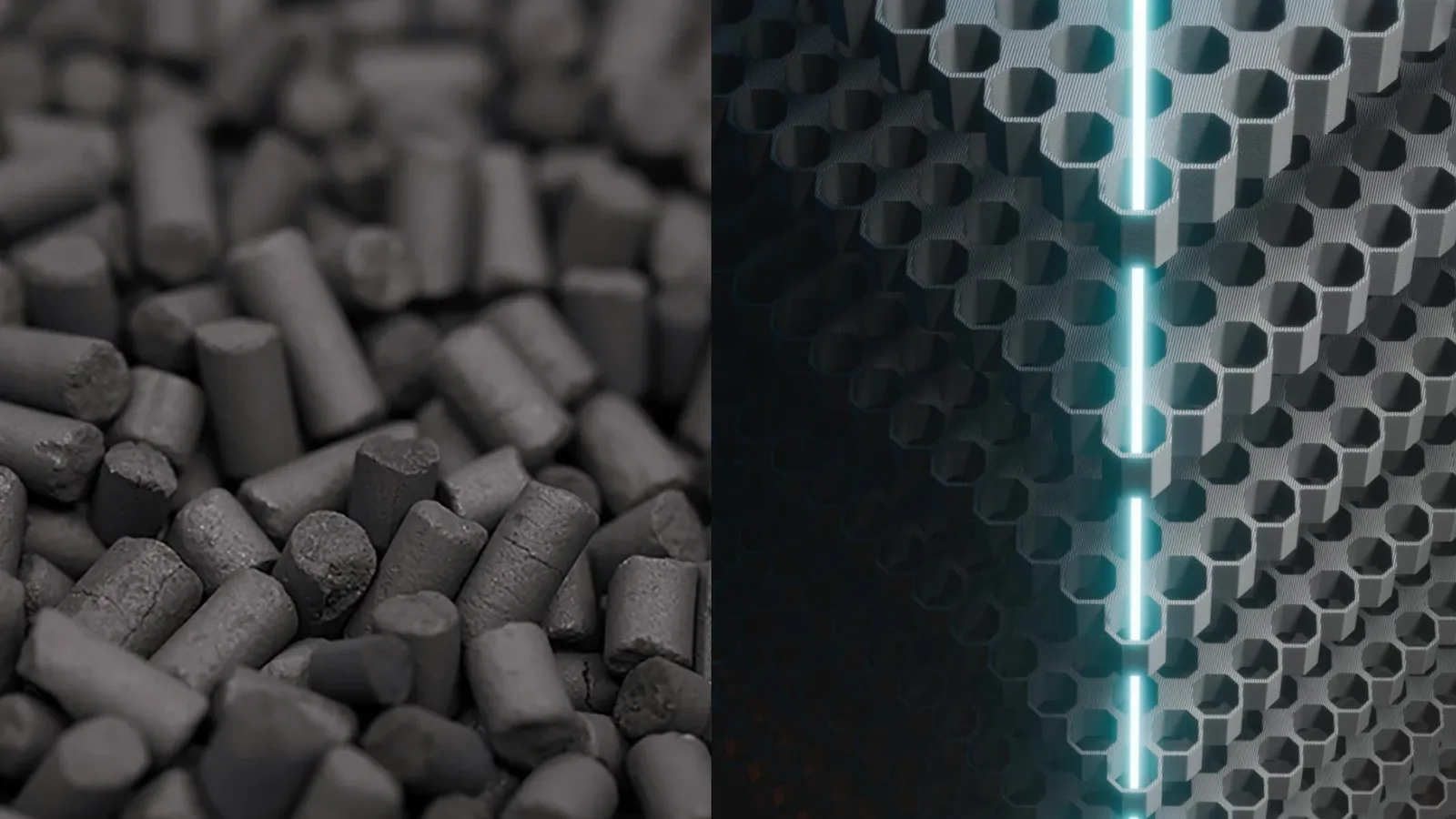
Instead of forming granules or blocks, ACF is produced as ultra-thin, extremely porous fibers. These fibers create an enormous amount of exposed surface area far more than traditional carbon forms of the same volume.
What this means for speed:
When water enters a filter containing ACF, it immediately contacts thousands of active adsorption sites. There’s no need for contaminants to migrate deep into granules. Everything is essentially right at the surface, ready to bind with the carbon.
This high accessibility allows for:
- Rapid chlorine reduction
- Fast capture of volatile organic compounds (VOCs)
- Immediate improvement in taste and odor
- Strong interaction with small-molecule trace contaminants
Families notice the difference quickly water flows smoothly, and filtration performance begins instantly.
2. Uniform Flow = Consistent Contact
The way water moves through a filter is just as important as the filter media itself.
ACF forms a tight, uniform matrix, allowing water to pass evenly through the fibers from all directions. This ensures that each part of the media contributes to filtration, instead of allowing water to flow around certain areas.
Why this matters:
- More consistent interaction between carbon and contaminants
- Predictable performance at both low and high flow rates
- Reduced risk of uneven flow zones that affect reduction efficiency
This structural uniformity is one of the key reasons ACF performs so reliably under real household usage whether someone is filling a pot, washing produce, or quickly grabbing a glass of water.
3. Faster Adsorption Kinetics
One of the most defining advantages of ACF is the speed of its adsorption kinetics the rate at which contaminants attach to the surface of the carbon.
Because the fibers expose nearly all adsorption sites directly to flowing water, contaminants bind extremely quickly. This gives ACF a measurable advantage when it comes to reducing challenging, fast-moving compounds.
Faster kinetics benefit:
- Chlorine and chloramine reduction is nearly instantaneous
- Organic chemicals and THMs are captured more efficiently
- Small, low-concentration contaminants bind before passing through
- Performance remains strong even when flow increases
This is what allows ACF-based systems like the Purely P1 to maintain exceptional filtration without requiring slow flow rates or long dwell times.
4. Designed for Modern Water Chemistry
Today’s municipal water often contains micro-contaminants that weren’t widely discussed decades ago: PFAS, pharmaceutical traces, pesticide metabolites, cosmetic residues, and other emerging chemicals.
These compounds are small, mobile, and present in very low concentrations making them more difficult for older filtration structures to interact with efficiently.
ACF is particularly effective here.
Thanks to its micro-porous structure and accessible surface area, activated carbon fiber filtration has strong affinity for these hard-to-capture molecules, allowing them to bind quickly and consistently.
Real-world advantage:
- Better interaction with low-molecular-weight organics
- Faster capture of modern trace contaminants
- High reduction performance across a broader range of chemical categories
- More stable performance over the lifespan of the filter
This doesn’t replace other filtration technologies it simply enhances what is possible within a compact, highf low point-of-use system.
5. High Performance Without Sacrificing Flow
The challenge with many filtration technologies has always been the trade-off between flow rate and reduction performance. Slower water often means more effective filtration, but it comes at the cost of everyday convenience.
ACF helps eliminate that trade-off.
Its open fiber structure allows water to move smoothly while still maintaining high contact with the media.
Impact for households:
- Comfortable, natural flow at the faucet
- Fast reduction without restricting water movement
- Reliable performance even during high-demand usage
- Less frustration during cooking, cleaning, and filling bottles
This is one of the reasons ACF is ideal for families it keeps filtration performance high without slowing daily routines.
6. Structural Stability for Long-Term Speed
All filter media change over time as they interact with water and contaminants. What’s unique about ACF is how well it maintains its form and function throughout its lifespan.
The fiber matrix resists compaction and preserves its pore structure, allowing it to retain fast adsorption kinetics for thousands of litres of use.
Long-term benefits:
- Stable flow rate
- Consistent contaminant reduction
- Less compaction over time
- Predictable performance from start to finish
This durability contributes to ACF’s overall speed filtration remains responsive and efficient from the first litre to the last.
7. A Perfect Match for Compact, Modern Systems
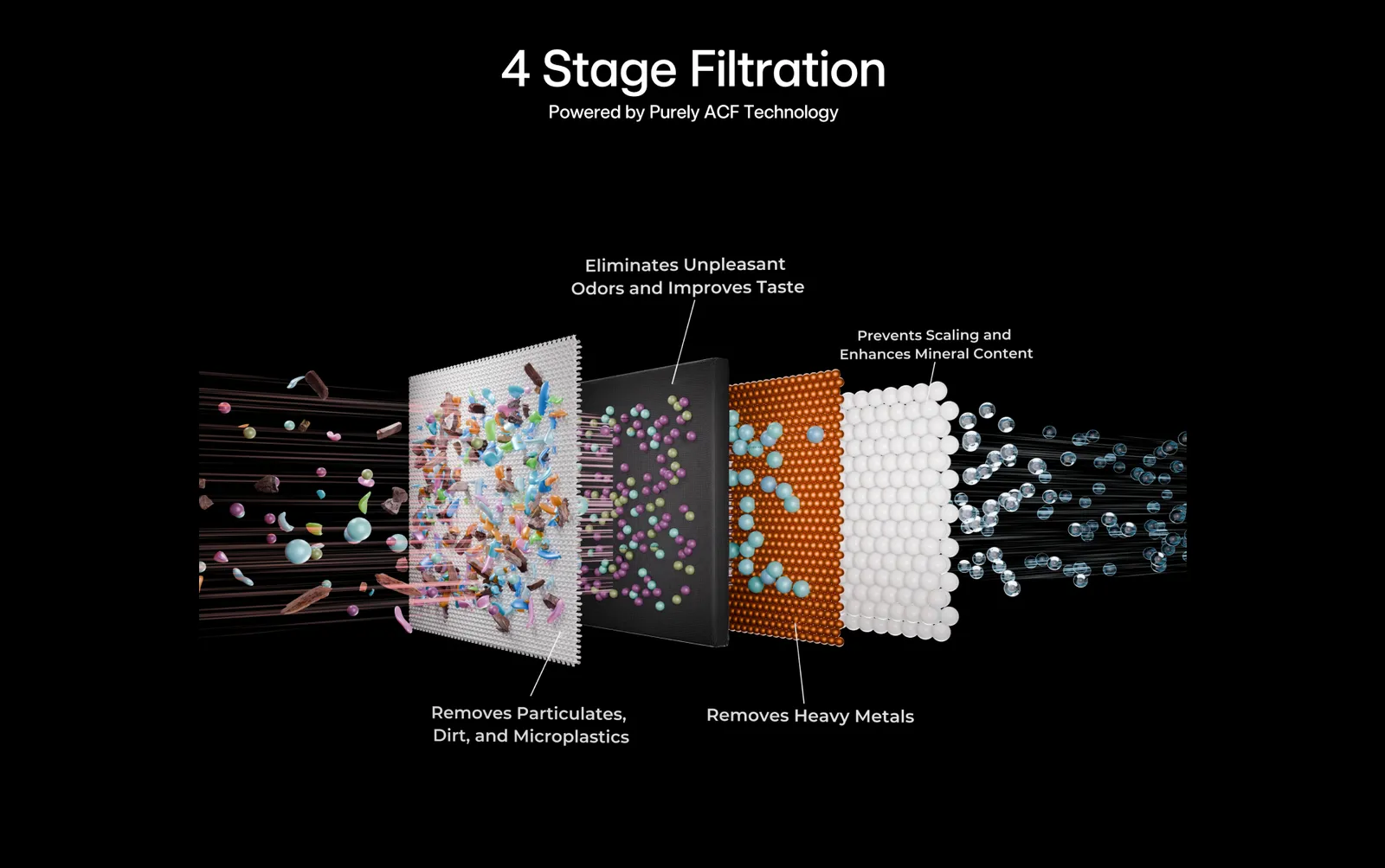
Because ACF is so efficient, it doesn’t require large housings or long contact chambers to perform well. This makes it ideal for sleek, under-sink systems like the Purely P1, where space, flow rate, and contaminant range all matter.
Families get the advantages of:
- High-quality filtration in a small footprint
- Faster water delivery
- Superior performance without a bulky setup
- Cleaner design and a simpler user experience
It’s a more modern approach to point of use water filtration one designed for the realities of today’s households.
The Bottom Line
Activated Carbon Fiber represents a meaningful step forward in home water filtration. By making the carbon surface more accessible and the adsorption process dramatically faster, ACF delivers the speed, consistency, and modern performance families expect today all while complementing the same fundamental principles that have made carbon a trusted filtration medium for decades.
Fast, efficient, and engineered for today’s water.
That’s the value of ACF and why it’s at the core of Purely’s approach to better, cleaner drinking water.