Water treatment plants in North America do a good job of disinfecting and preparing water for distribution. The main issue lies in the journey water makes after leaving the facility.
As it travels through miles of aging, reactive infrastructure, it can pick up sediments, metals, organic compounds, and trace contaminants before it finally reaches your faucet.
This is why a properly engineered under-sink water filter essential for tap water purification at home.
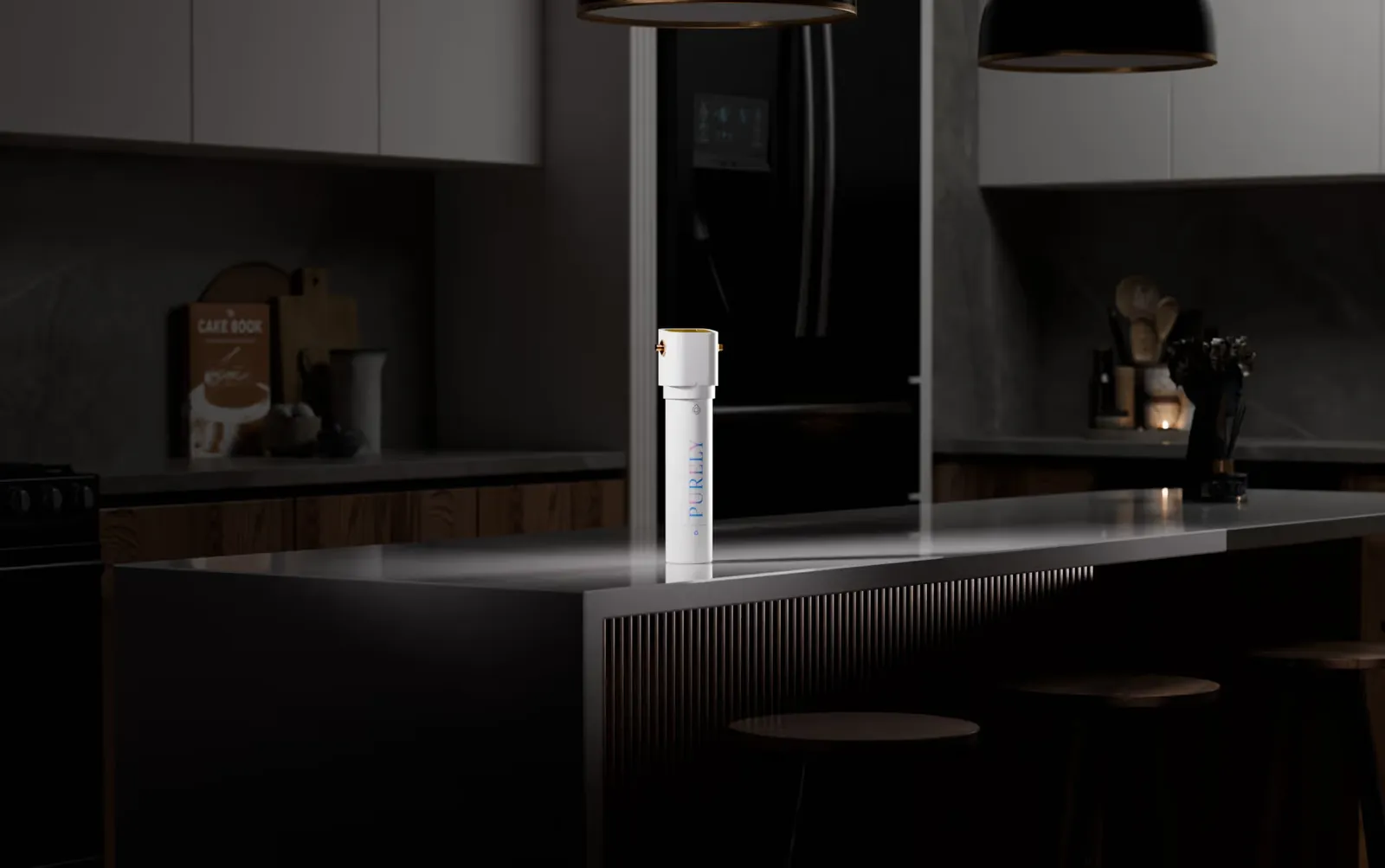
Purely’s P1 under-sink system was designed specifically for modern water challenges. Using a four-stage approach PP5UM sediment filtration, Activated Carbon Fiber (ACF), Filtersorb SP3, and KDF55 the P1 tackles the broad spectrum of contaminants most commonly found in North American tap water today.
Its advanced filtration technology delivers reliable contaminant removal without changing water pressure or taste.
Below, we break down the main contaminants found in tap water, how they get into your water, and exactly how each stage of the P1 removes or treats them.
1. Chlorine & Chloramine
Why they're so common
Municipalities add chlorine or chloramine as disinfectants. They’re effective at killing microbes and bacteria, but they create side effects:
- Chemical smell or taste
- Formation of disinfection byproducts (THMs)
- Accelerated wear on plumbing components
Most people notice chlorine immediately the “pool-water” smell and taste.
How the Purely P1 removes them
Stage 2 – Activated Carbon Fiber (ACF)
- ACF’s ultra-fine fibers create a massive surface area.
- This gives chlorine and chloramine thousands of contact points as water passes through.
- As a result, they’re adsorbed quickly and consistently, even at higher flow rates.
Stage 4 – KDF55 Redox Media
- KDF stabilizes chlorine and helps reduce remaining disinfectants.
- It also prevents bacterial growth inside the filter housing.
The combination of ACF + KDF is highly effective at removing chlorine and chloramine in a drinking water filter.
2. Lead & Other Heavy Metals
Why they appear in tap water
Most heavy metals don’t come from water plants, they come from pipes and plumbing inside cities and buildings.
Lead service lines, old solder, brass fixtures, and corroding infrastructure all contribute.
Exposure to metals like lead, mercury, cadmium, and chromium can affect cognition, cardiovascular systems, and long-term cellular health.
How the Purely P1 removes heavy metals
Stage 4 – KDF55 Redox Media
This is the P1’s heavy metal removal water filter component. KDF works through a controlled redox reaction:
- Converts dissolved metals into insoluble, non-absorbable forms
- Binds and captures many heavy-metal ions
- Reduces lead, mercury, arsenic species, copper, and more
The result is cleaner, safer water with meaningful protection from the heavy metals commonly found in municipal and household plumbing.
3. Sediment, Rust, Pipe Scale & Physical Particles
Where they come from
Sediment is one of the most overlooked contaminants in tap water. It includes:
- Rust flakes from aging pipes
- Sand and sil
- Pipe sca
- Dirt and physical debris
- Microplastics
These particles aren’t always visible, but they affect taste, clarity, and long-term plumbing health.
How the Purely P1 removes them
Stage 1 – 5-Micron Polypropylene Sediment Filter (PP5UM)
This first stage captures:
- Rust
- Sand
- Silt
- Dirt
- Microplastics
- Larger organic particles
By removing these upfront, the PP5UM filter protects the next stages and keeps flow rate consistent.
Stage 2 – ACF Adds additional micro-particle polishing, removing the smaller organic and synthetic particles the PP5UM filter doesn’t catch. This contributes to a highly effective tap water purification process.
Together, they deliver visibly cleaner, crystal-clear water.
4. Volatile Organic Compounds (VOCs)
What they are
VOCs are industrial chemicals and solvents found in:
- Paints
- Plastics
- Gasoline
- Cleaning agents
- Manufacturing runoff
Municipal plants are not designed to remove many VOCs.
How the Purely P1 removes them
Stage 2 – Activated Carbon Fiber (ACF)
ACF’s microscopic fiber matrix adsorbs:
- Benzene
- Toluene
- Chloroform
- Industrial solvents
- Chemical residues
Its ultra-fine fiber structure provides exceptional contact time for VOC reduction, making it a high-performance home water purification component.
5. PFAS (“Forever Chemicals”)
Why PFAS are a growing concern
PFAS come from:
- Non-stick cookware
- Waterproof coating
- Food packaging
- Firefighting foam
- Industrial discharge
They persist in the environment and resist breakdown.
PFAS exposure has been linked to immune disruption, hormonal effects, fertility concerns, and increased cancer risk.
How the Purely P1 targets PFAS
Stage 2 – ACF
ACF’s high-surface-area fibers attract PFAS molecules through adsorption and electrostatic interaction — a key advantage when selecting a premium water filter for modern contaminants.
6. Trihalomethanes (THMs)
Why they form
THMs form when chlorine reacts with organic matter in the water supply. Long-term exposure may affect cellular health, liver function, and reproductive systems.
How the Purely P1 reduces them
Stage 2 – Activated Carbon Fiber (ACF)
- Adsorbs THM molecules quickly due to its high surface area
- Improves overall taste and odor
Stage 4 – KDF55
- Helps stabilize chlorine to limit further byproduct formation.
Together, these stages support reliable THM reduction in a point-of-use water filter.
7. Herbicides & Pesticides
How they enter water
Agricultural regions experience runoff containing:
- Atrazine
- Glyphosate
- Simazine
- Other crop treatments
Even in cities, trace agricultural chemicals can find their way into rivers and lakes and eventually into drinking water.
How the P1 removes them
Stage 2 – ACF
Organic pesticide molecules are naturally attracted to ACF’s fiber structure, making it effective for contaminant removal.
8. Pharmaceuticals & Hormone-Disrupting Compounds
Why they appear in tap water
Medication residues enter water systems when:
- People flush unused pills
- Wastewater treatment doesn’t fully break down compounds
- Trace amounts pass through human digestion and end up in waterways
Municipal treatment plants were never designed to handle these compounds.
How the Purely P1 reduces them
Stage 2 – ACF
Its adsorption characteristics allow it to capture many pharmaceutical molecules and endocrine disruptors, strengthening the system’s role as a dependable drinking water filter.
9. Hard Water Minerals, Scale & Limescale Buildup
Why this matters
Calcium and magnesium minerals cause:
- Limescale stains
- Film on faucets and fixtures
- Reduced appliance lifespan
- Clogged aerators and valves
Traditional filters either remove minerals entirely or don’t address scaling.
How Purely treats minerals without removing them
Stage 3 – Filtersorb SP3 (NAC Technology)
Filtersorb SP3 uses a form of catalytic media known as Nucleation Assisted Crystallization(NAC). Instead of softening water by removing minerals, NAC changes the structure of hardness minerals mainly calcium and magnesium as they pass through the media.
Here’s how it works:
- As water flows over the SP3 media, hardness minerals form micro-crystals on the surface.
- These crystals detach almost instantly and remain suspended in the water.
- Once crystallized, the minerals become stable and non-reactive, meaning they can’tattach to pipes, fixtures, kettles, or appliances.
This transformed mineral form:
- Doesn’t stick to pipes or fixtures
- Doesn’t form limescale
- Doesn’t alter taste or texture
- Doesn’t remove healthy minerals from your drinking water
Where traditional softeners strip minerals out of water, NAC simply neutralizes their ability to cause buildup. You keep the natural mineral profile without the scaling.
10. Taste, Odor & Aesthetic Issues
Where these issues come from
- Chlorine
- Organic matter
- Old pipes
- Hydrogen sulfide
- Biofilms
- Seasonal water changes
How the P1 fixes taste and odor
Every stage contributes:
- PP5UM filter removes physical debris carrying odor-causing compounds
- ACF eliminates chlorine and musty flavors
- Filtersorb SP3 stabilizes minerals for a crisp taste
- KDF55 prevents internal bacterial growth and stabilizes disinfectants
The result is consistently clean, crisp, refreshing water.
How the Four Stages Work Together
Stage 1 — PP5 Micron Sediment Filter
Captures physical contaminants like rust, sand, dirt, and microplastics.
Stage 2 — Activated Carbon Fiber (ACF)
Removes chlorine, VOCs, PFAS, pesticides, pharmaceuticals, THMs, and more.
Stage 3 — Filtersorb SP3 (NAC)
Prevents scaling while preserving healthy minerals.
Stage 4 — KDF55
Reduces heavy metals, stabilizes chlorine, and prevents bacterial growth.
Together, these create a balanced, efficient water purification system for modern homes.
Final Thoughts
Clean water isn’t just about removing one or two contaminants, it’s about addressing the full spectrum of modern water challenges.
The Purely P1 was built for exactly that. With its four-stage architecture, it removes physical particles, adsorbs chemicals, stabilizes minerals, and targets heavy metals in a single, compact under-sink water filter.
The result is simple: safer water, cleaner taste, healthier living, and peace of mind for your home.