Pregnancy has a way of making us second guess ordinary lifestyle choices.
Food labels get a closer look. Household products raise new questions. Sleep, air quality, and daily routines can suddenly carry more weight because they don’t just affect our bodies, they affect our babies development in the womb.
Water deserves to be part of the conversation.
A developing baby depends on a steady supply of water throughout pregnancy. Water makes up roughly 75% of an infant’s body [15% more than a full-grown adult] and is a major component of organs including the brain, heart, kidneys, and lungs. That makes maternal hydration an important part of supporting normal growth. A 2024 paper published by the Center on the Developing Child at Harvard University notes that dehydration during pregnancy can contribute to decreased fetal weight and length at birth. [1]
It’s clear that adequate hydration is necessary for a healthy baby, but that raises another question: if the water we consume daily plays such a basic role in fetal development, does the quality of that water matter too?
Research suggests that, in some cases, it can. Knowing what is actually in your local tap water is the first step in that conversation.
The Risks of Exposure are Higher in Prenatal Life
Pregnancy is a period of unusually rapid development. A fetus is building organs, neural pathways, metabolic systems, and other biological structures in a short period of time.
During this stage, some contaminants commonly found in tap and bottled water can cross the placenta and reach the fetus. A paper published by the Center on the Developing Child at Harvard University explains that protective systems around the developing brain are weaker during prenatal life and early infancy. [1]
That is why researchers pay close attention to prenatal exposure. Three contaminants are especially relevant to this conversation.
Lead
Lead is one of the best-known examples. Prenatal lead exposure has been associated with adverse pregnancy outcomes and impaired brain development, including effects on cognition and attention later in childhood. [1]
Nitrates
Nitrates are another concern, particularly in areas affected by agricultural runoff. High nitrate exposure has been associated with birth defects. In infants, high nitrate levels in water used to prepare formula can also cause methemoglobinemia, often called “blue baby syndrome,” which interferes with the blood’s ability to carry oxygen. [1]
PFAS
PFAS, sometimes called “forever chemicals,” have also drawn attention in pregnancy research. The Harvard paper discusses evidence that PFAS can affect placental growth and accumulate in fetal tissues, including the brain, liver, kidneys, and placenta. Researchers are continuing to study what those exposures may mean for later development and metabolic health. [1]
The point is not that these substances pose the same risks at any level of exposure. They do not. The point is that pregnancy can make the timing and amount of certain exposures more acute.
What Researchers Found in Compliant Water
One of the more interesting questions is whether water quality can matter even when a public water system is meeting regulatory standards.
A 2023 working paper from the National Bureau of Economic Research by Rebecca DiSalvo and Elaine Hill examined more than 1.2 million births in Pennsylvania between 2003 and 2014. [2]. The researchers looked at contaminant concentrations in community water systems that did not have regulatory violations.
They found that moving from relatively low to relatively high levels of cumulative contaminant exposure was associated with a 12% increase in the likelihood of low birth weight and a 17% increase in the likelihood of preterm birth. [2]
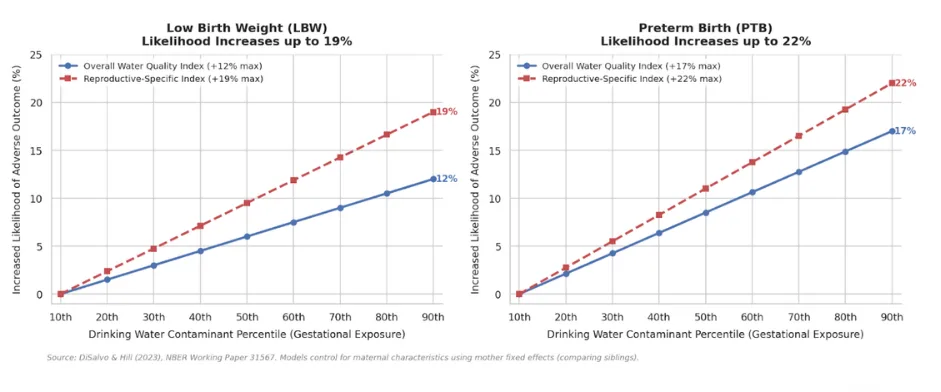
That finding adds an important layer to the conversation.
Regulatory standards play an essential role in protecting public health. But a legal threshold and a scientific study are not necessarily asking the same question. One asks whether a water system is operating within established limits. The other may ask whether differences in exposure within those limits are still associated with measurable risks.
The study does not suggest that drinking water meeting regulatory standards is broadly unsafe. Rather, it indicates that the potential effects of cumulative, lower-level exposures during pregnancy warrant further investigation. It is a reminder that even clean city water can deserve a final polish.
Presence Is Not the Same as Danger
This nuance matters.
Modern laboratories can detect substances at extremely small concentrations. Finding something in water does not, by itself, tell us whether the exposure is likely to cause harm. Concentration matters. So does timing, frequency, and the evidence surrounding that specific substance.
That is why the study cited above should be interpreted carefully. It identifies a population-level association between higher cumulative exposure and certain birth outcomes. It does not mean that every detectable contaminant presents the same concern, or that every pregnant person exposed will experience an adverse outcome. [2]
The useful question is not simply, “Is something there?” It is, “How much is there, how much exposure is occurring, and what does the evidence say about it?”
Why Expecting Families Are Looking More Closely
Water is consumed every day. Pregnancy is a sensitive period of development. And research suggests that some exposures in drinking water may be associated with meaningful birth and developmental outcomes.
Those three facts are enough to explain why more expecting families are paying attention. Families with young children often look at water quality for moms, babies, and families in the same light.
They do not justify fear of every detectable substance. They do not mean all water presents the same concerns. And they do not require a pursuit of perfect water.
They simply make a stronger case for understanding what is actually present, how much exposure may be occurring, and what the evidence says about it.
If you’re expecting, here’s a useful takeaway: the water you consume daily deserves attention because it is a constant part of daily life, and pregnancy is one of the periods when understanding that exposure can matter most. A quick way to start is to check your local water report, then decide whether a system like the Purely P1 under-sink filter fits your home.
Sources
1. Early Childhood Scientific Council on Equity and the Environment. (2024). “A Cascade of Impacts: The Many Ways Water Affects Child Development.” Working Paper No. 2. Center on the Developing Child, Harvard University.
2. DiSalvo, R., & Hill, E. L. (2023). “Drinking Water Contaminant Concentrations and Birth Outcomes.” National Bureau of Economic Research Working Paper Series, No. 31567.