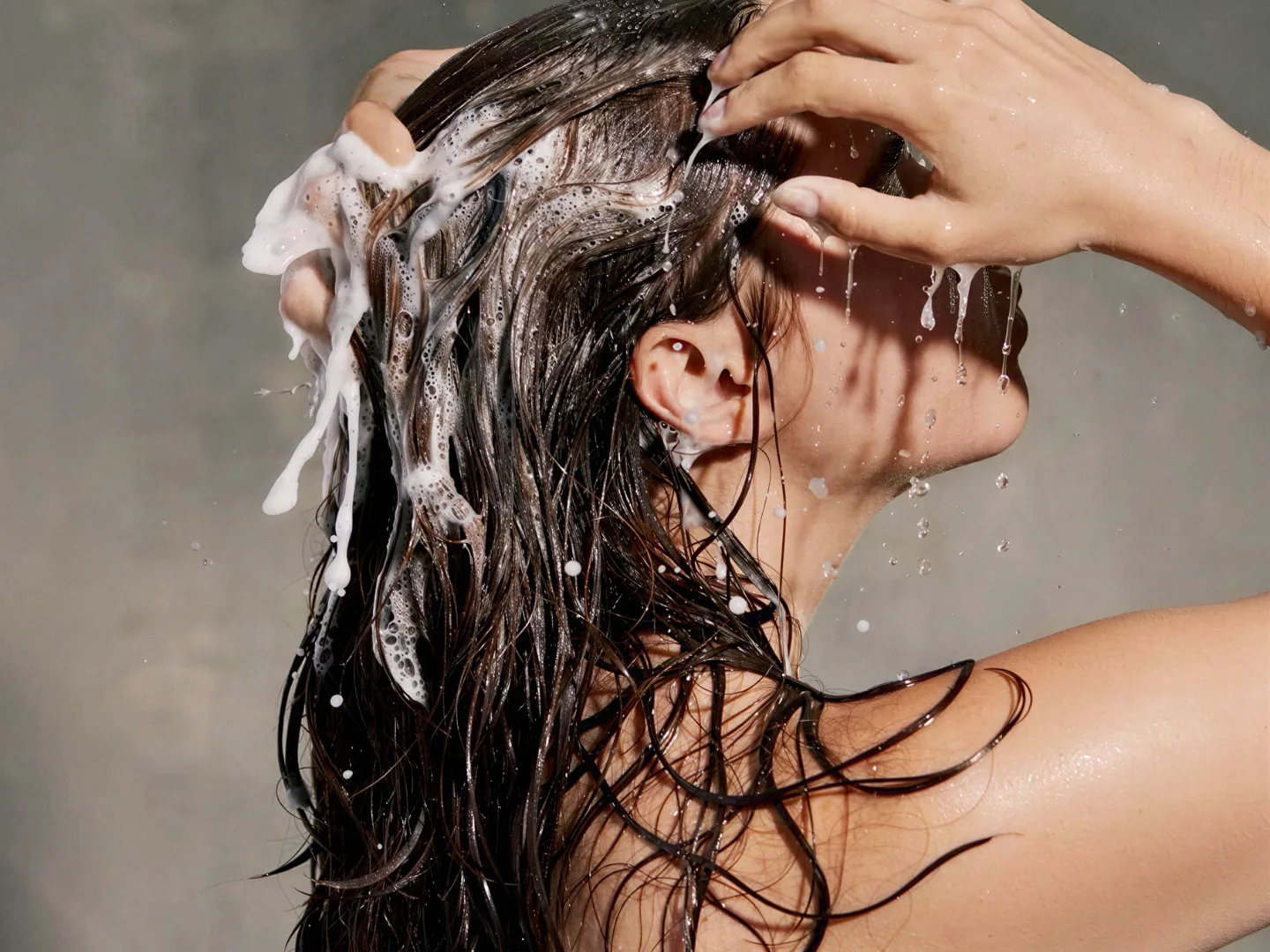
You buy the hydrating shampoo. You use the hair mask. You add leave-in conditioner, oils, and heat protectant. Yet somehow, your hair still comes out of the shower feeling rough, frizzy, or harder to manage than you would expect.
What if part of the problem isn’t your products, your diet, or even your genetics—but something most people never think to check: the water coming out of your shower?
Your hair spends a surprising amount of time in direct contact with shower water. Municipal water is commonly treated with chlorine, a disinfectant used to control bacteria and other pathogens. But the same chemistry that makes chlorine useful as a disinfectant can also affect your hair, skin, and scalp.
Research on chlorine exposure suggests that repeated contact can contribute to changes in the hair fibre and skin barrier. A recent dermatology review describes chlorine as one of several environmental factors that can contribute to the deterioration of keratin and the cuticle. [1]
That doesn’t mean your shower water is “bad” or that chlorine is destroying your hair every time you wash it. It means that if dryness, roughness, or scalp tightness keeps returning despite a thoughtful hair-care routine, the quality of the water touching your hair every day is worth considering. A quick way to see what you’re working with is to check your local water report.
Your Hair Cannot Repair Itself the Way Your Skin Can
To understand why repeated exposure matters, it helps to understand what a strand of hair actually is.
A strand of hair is actually “dead” tissue made mostly of keratin, a tough structural protein. It has three main layers: the cuticle on the outside, the cortex underneath, and a central medulla that may be present within the fibre. [2]
The cuticle is the part that matters most when we talk about how hair feels. It consists of overlapping, scale-like cells that protect the inner cortex. When those scales lie relatively smooth and intact, the strand has a lower-friction surface and tends to feel smoother and reflect light more evenly.
Unlike “living” skin, however, your hair strands can’t heal once the structure has been damaged. Conditioners and treatments can coat, lubricate, reinforce, or temporarily smooth damaged areas, but the fibre itself does not grow new cuticle cells.
That is why small, repeated stresses can have a compounding effect. Hair damage is often cumulative. And this brings us back to your shower water.
Chlorine Can Add Oxidative Stress to the Hair Fibre
Chlorine is an oxidizing disinfectant—a chemistry term for reacting in ways that can change or break down other substances. That property is exactly what makes it useful for water treatment.
Hair proteins, however, can also be affected by oxidative stress. A 2025 review of environmental influences on hair reports that chlorine exposure can accelerate the breakdown of keratin while also compromising the cuticle. [1]
Consumer-facing dermatology literature describing chlorinated-water exposure also reports a lifting of the overlapping cuticle scales, followed by hair that feels rougher and more brittle. [2] This is the same mechanism behind why chlorine removal matters in home filtration.
Why does a lifted cuticle make such a noticeable difference?
Once the outer surface becomes rougher, neighbouring strands create more friction against each other. Hair can tangle more easily, become harder to comb, lose some of its shine, and become more vulnerable to mechanical breakage. Imagine your hair strand all of a sudden has hooks that latch on to neighboring strands creating that all too familiar breakage.
That being said, concentration, contact time, frequency, and the pre-existing condition of your hair all play a role in the severity of damage chlorinated water can have on your hair.
But the underlying lesson is useful. If your hair is already porous, bleached, coloured, heat-styled, or mechanically stressed, repeated exposure to another oxidizing stressor may matter more than it would on untouched hair.
Your Scalp Has a Protective Barrier Too
The hair shaft is only half of the story. The scalp is living skin, and it depends on a very different kind of protection.
Glands in your scalp produce sebum, which helps lubricate the scalp and hair. At the same time, the skin barrier helps slow water loss and limits how easily outside irritants can penetrate the skin. [3]
When that barrier is disrupted, transepidermal water loss, or TEWL, can rise. In simple terms, more water escapes through the skin, which can contribute to the familiar sensations of dryness, tightness, and irritation.
Research involving swimmers has linked repeated chlorinated-water exposure with dry or irritated skin, and reviews of shower-water quality similarly identify chlorine exposure as a possible contributor to scalp discomfort. [4] It’s a pattern we explore further in how your water affects your hair and skin.
Again, dose matters. Pool exposure is not identical to taking a shower.
And temperature belongs in that discussion too. A very hot, long shower can be harder on an already-dry skin barrier than a shorter warm one. If your scalp feels tight immediately after washing, changing both the water chemistry and the way you shower may be more useful than adding another product afterward.
How to Make Your Shower Routine Gentler on Hair and Scalp
If chlorine and other contaminants in your shower water are contributing to dryness, brittleness, or scalp irritation, one of the most direct ways to address that exposure is to filter the water before it reaches your hair.
A shower filter treats the water at the point where it actually comes into contact with your hair and scalp. A Purely shower filter can provide that point-of-use treatment without adding unnecessary complexity to the rest of your water system.
The important part is not simply having a filter. It is using a filter with verified performance for the contaminants you actually want to reduce. If you want to dig into that side of it, our guide on how shower filters reduce chlorine for skin and hair comfort covers what to look for.
Hair products can help manage dryness after it occurs. Filtering your shower water addresses one of the potential causes before it ever reaches your hair.
Better Hair Care May Start Before the Shampoo
It’s easy to assume that persistent dryness means you haven’t found the right mask, oil, or conditioner yet.
Sometimes that’s true.
But every hair product is an add-on to a foundational part of your routine that receives much less attention: the water itself.
Sometimes healthier-feeling hair is not about adding one more product. It is about changing what touches your hair every single time you wash it. Start by understanding what’s in your local water, then decide whether a shower filter fits your home.
Sources
1. Cedirian, S., Prudkin, L., Piraccini, B. M., et al. “The Exposome Impact on Hair Health: Etiology, Pathogenesis and Clinical Features — Part I.” Anais Brasileiros de Dermatologia, 2025;100(1):131–140.
2. Typology. “Chlorinated Water, Its Effects and Inconveniences on Hair.” Overview of hair structure and the effects of repeated chlorinated-water exposure on the cuticle.
3. Regimen Lab. “What Is the Skin Barrier and Why Does It Matter?” Overview of skin-barrier and moisture-barrier function.
4. Maitra, A., & Talati, A. “Chronic Effects of Swimming Pool Disinfectants on Skin and Hair.” Open Access Research Journal of Biology and Pharmacy, 2024;12(2):009–015; and MDhair, “How Tap Water Contaminants Impact Your Skin and Hair?”