The right pick depends on what's in your water and what you want to fix. This guide compares how each filter works, what each one removes, and what each costs to install and keep up. It also covers a third option most guides skip: carbon in fibre form.
Quick answer: For most homes on city water, like Montreal's, a carbon filter handles what people notice most: the taste and smell of chlorine, and the byproducts chlorine leaves behind. Reverse osmosis (RO) goes further on fluoride, nitrate and dissolved salts. But it costs more, wastes water and strips out minerals. Worried about lead from older pipes? Acid-treated carbon fibre reduces lead too, without RO's downsides.
Carbon vs reverse osmosis at a glance
| Activated carbon | Reverse osmosis | |
|---|---|---|
| How it works | Contaminants stick to the carbon | A membrane blocks dissolved substances |
| Chlorine taste and smell | Yes | Yes |
| Chlorine byproducts (THMs) and VOCs | Yes | Yes |
| Lead and heavy metals | Ordinary granular carbon: limited. Acid-treated carbon fibre: yes | Yes |
| PFAS | Yes, depending on the media | Yes |
| Fluoride and arsenic | Not carbon alone; the P1 adds an activated alumina stage for these | Yes |
| Nitrate and dissolved salts | No | Yes |
| Calcium and magnesium | Kept | Removed |
| Water sent down the drain | None | 3 to 20 L per litre on older units; about 1 L for every 2 L on newer tankless models |
| Installation | Often DIY | Usually a plumber |
How an activated carbon filter works
Activated carbon is carbon that has been treated to create a huge surface full of tiny pores. As water flows through, many contaminants stick to that surface and stay behind. This is called adsorption.
Carbon is the go-to choice for chlorine taste and smell. It also reduces chlorine byproducts like trihalomethanes (THMs), many volatile organic compounds (VOCs) and some pesticides.
It has limits. Carbon doesn't remove fluoride, nitrate or dissolved salts, and it doesn't kill bacteria. Ordinary granular carbon also holds on to very little dissolved lead. Specially treated carbon fibre is a different story, as you'll see below.
You'll find carbon in pitchers, fridge filters, faucet filters, under-sink systems and whole-home systems. How well it works depends on how much carbon the water touches, and for how long.
How a reverse osmosis system works
Reverse osmosis uses your home's water pressure to push water through a very fine membrane. Water gets through. Most dissolved substances don't. They get flushed down the drain with a stream of reject water.
According to Alberta Agriculture, RO removes 85 to 98% of total dissolved solids. That makes it the strongest home option for fluoride, nitrate, arsenic and salts. Chlorine damages most membranes, so almost every RO system also has carbon filters before and after the membrane.
The trade-offs are real:
- It wastes water. Small home units send 3 to 20 litres down the drain for every litre you drink, per the same Alberta guide. Newer designs do better, but none reach zero.
- It removes minerals. Health Canada notes that RO strips out calcium and magnesium. It adds that food, not water, is your main source of these minerals. Some people still find RO water tastes flat.
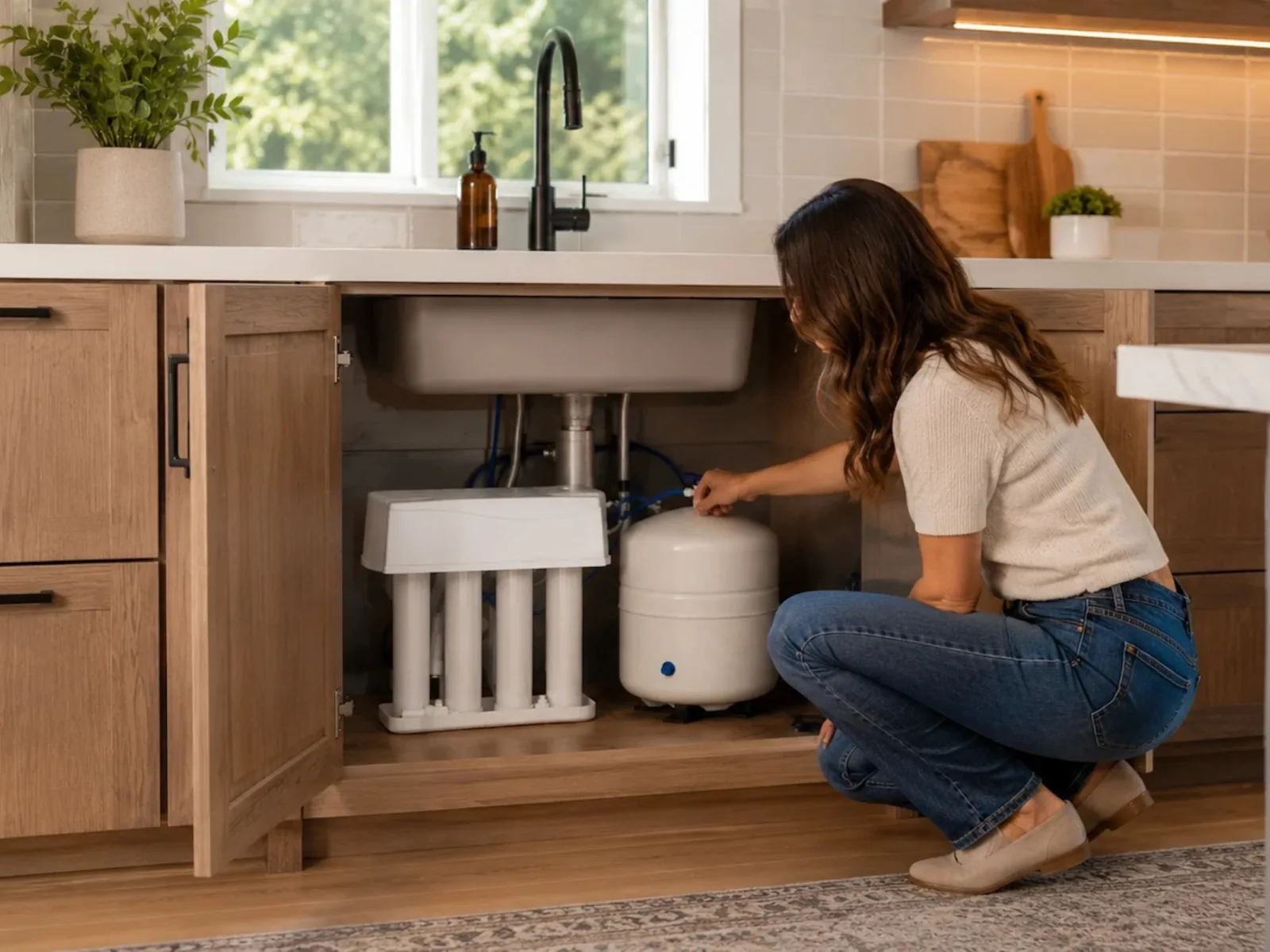
- It needs more hardware. Most systems need a storage tank or pump, a separate faucet and a drain connection.
Not sure which problems your tap water actually has? Enter your postal code in Purely's free Water Report to see what's been found in your area.
What this means for Montreal homes
Montreal's treated water meets Quebec's standards. The City doesn't add fluoride, as our fluoride guide explains. In the City's 2025 results, lead was once again over the limit. It comes from old pipes in some buildings, not from the treatment plants.
So for most Montreal homes, RO's biggest strengths solve problems the tap water doesn't have. The issues that do show up are chlorine taste, chlorine byproducts and, in older buildings, lead. Our guide Is Montreal Tap Water Safe to Drink? covers the full picture.
Cost comparison: install and upkeep
The price tag is only part of the cost. The rest comes from installation, cartridge changes and, for RO, the water that goes down the drain.
All prices in this guide are in Canadian dollars, before tax.
| Under-sink carbon fibre (P1) | Under-sink reverse osmosis | |
|---|---|---|
| Equipment | $260 | About $450 to $700 for popular brands; $1,500 to $2,400 installed for dealer systems |
| Installation | DIY in about 10 minutes; connects to the cold-water line | Often a plumber, about $150 to $400 in Montreal |
| Ongoing filters | One $159 cartridge every 2 years or about 22,000 L | Pre- and post-filters every 6 to 12 months, plus a membrane every 2 to 5 years: about $50 to $220 a year |
| Water to the drain | None | 3 to 20 L per litre on older units; about 1 L for every 2 L on newer tankless models |
| Minerals | Kept | Removed, unless you pay for a remineralizing stage |
| Flow at the tap | Normal | Slower; relies on a tank or pump |
| Works in a rental? | Usually, with no drilling | Harder; often needs a new faucet hole and an outlet |
RO installation and upkeep ranges come from Montreal plumbers Plumbing Montreal and Montréal Plomberie.
What reverse osmosis costs in Canada
We checked Canadian prices for six of the most popular RO brands sold here.
| Brand and model | Type | Price (CAD) | Ongoing costs | Good to know |
|---|---|---|---|---|
| Waterdrop G3P600 | Tankless, under the sink | $699 ($579 on sale) | Filters at 6, 12 and 24 months: about $220 a year | Needs a drain connection, its own faucet and an outlet |
| Frizzlife PD600 | Tankless, under the sink | $570 ($500 on sale) | Sold with two-year filter bundles | Needs a drain connection and its own faucet |
| iSpring RCC1P | Under the sink, with tank and pump | $449 | Standard-size filters | The tank takes up cabinet space |
| AquaTru Classic and Carafe | Countertop, no plumbing | $511 to $660 | Main filters rated up to 24 months | You fill it by hand, and it takes counter space |
| Culligan (Quebec) | Rental, under the sink | $1.39 to $1.65 a day (about $507 to $602 a year) | Filters every 1 to 2 years; yearly disinfection recommended | Installation extra; not available in all regions |
| Kinetico K5 | Dealer installed | About $1,500 to $2,400 installed | $60 to $300 per filter set, every 6 to 12 months | Quote-based; figures from a Canadian dealer |
Prices checked October 27, 2026. Sale prices change often.
What five years really costs
Take the P1 Under-Sink as an example. The system costs $260 and a new cartridge costs $159. Each cartridge lasts up to 2 years or about 22,000 L, whichever comes first. Over five years, that's the system plus two cartridges: about $578 before tax. No plumber, and no wasted water.
Now compare a popular tankless RO system, the Waterdrop G3P600. The system costs $579 to $699. Over five years, you'd replace its first filter about 9 times ($49.99 each), its second filter 4 times ($44.99 each) and its membrane twice ($149 each). That's about $928 in filters, for a five-year total of roughly $1,500 to $1,630 before tax. Add $150 to $400 if you hire a plumber to install it.
Whatever you choose, change your cartridges on time. An overdue filter stops doing its job.
The third option: activated carbon fibre
Most guides treat this as a two-way choice: simple carbon or thorough RO. There's a third option. It keeps carbon's simplicity and fixes its two biggest weak spots: wasted carbon and poor heavy-metal capture.
The problem with ordinary carbon
In a bed of loose carbon granules, water takes the easiest path. It carves channels through the media and skips past carbon it never touches. This is called channeling, and it means part of the filter does little work. Carbon blocks avoid loose granules, but they use plastic binders that take up space the carbon could use.
Pores right on the surface
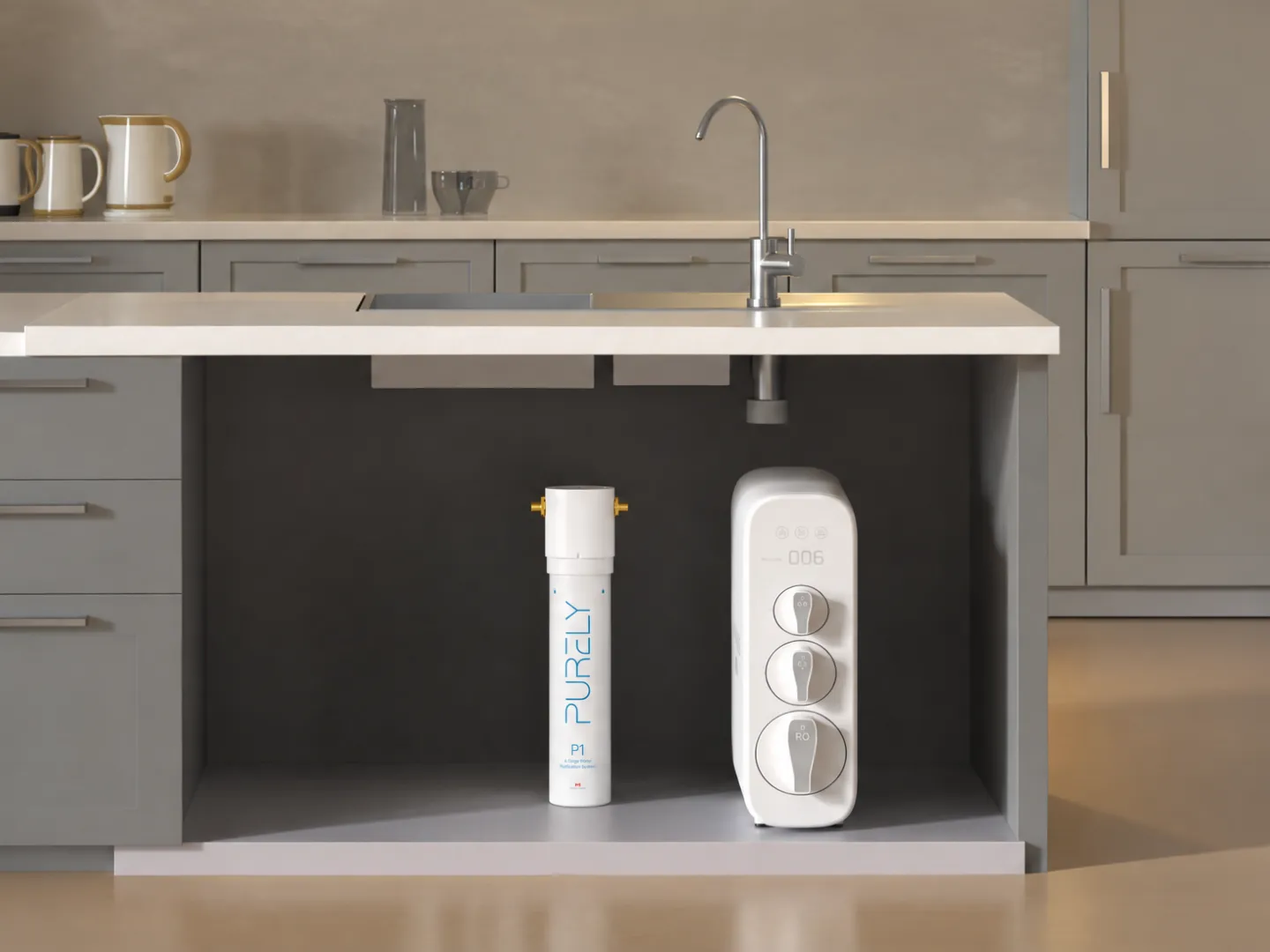
Purely's P1 Under-Sink uses Nanofiber™ media: activated carbon fibre (ACF) woven into fine, tight strands.
In granular carbon, pores run deep into each grain, so contaminants have a long way to travel. Carbon fibre has its tiny pores right on the surface, as carbon maker Kuraray explains. Each fibre is just 10 to 30 microns wide, with 1,000 to 2,500 m² of surface per gram, according to fibre maker Kynol.
That design pays off. In one study comparing the two, carbon fibre held much more lead, chromium and nickel than granular carbon, and it captured them faster. Speed matters under a sink, where water passes through the filter in seconds. The fibres also spread water evenly, which cuts down on channeling.
Acid-treated to grab heavy metals
Lead in tap water is dissolved as tiny particles with a positive charge, called ions. Ordinary carbon has few spots that can hold on to them.
Acid treatment changes that. It adds oxygen-based groups to the carbon surface. In water, these groups carry a negative charge, so they attract and hold positively charged metals like lead, as lead studies show. One study of acid-treated carbons ranked them for lead and nickel in this order:
- Acid-treated carbon fibre
- Untreated carbon fibre
- Acid-treated granular carbon
- Untreated granular carbon
Nanofiber™ media is acid-washed and oxygen-infused to add more of these negative sites.
Four stages in one cartridge
- PP5UM sediment (5 microns): catches rust, sand and silt
- Nanofiber™ activated carbon fibre: reduces chlorine, VOCs, heavy metals including lead, microplastics and PFAS
- Silver-Core™: helps prevent bacterial growth inside the filter
- Activated alumina: targets fluoride and arsenic
Together, the P1 is designed to reduce up to 99% of contaminants, including chlorine, lead, heavy metals, PFAS, microplastics and chlorine byproducts. Its activated alumina stage also targets fluoride and arsenic, two contaminants ordinary carbon filters can't handle.
What it keeps from carbon
- No wasted water. There's no drain line and no reject stream.
- Minerals stay in. Calcium and magnesium pass through.
- Full flow at your own faucet. No tank, no pump, no extra faucet.
- About 10 minutes to install, with no tools and no plumber.
- Up to 2 years or about 22,000 L per cartridge, with app tracking that tells you when it's time.
What it doesn't do
The P1 isn't a membrane. Its activated alumina stage targets fluoride and arsenic, but it won't reduce nitrate or dissolved salts the way RO does. If those show up on your water test, RO is the right tool.
Want lead and chlorine reduction without a plumber or wasted water? See how the P1 Under-Sink works →
Which home water filter should you choose?
Choose reverse osmosis if you're on a private well, a water test shows high nitrate or dissolved solids, or you want the broadest possible removal of everything dissolved in your water. You'll also need to be fine with a plumber, a tank or pump, and extra water use.
Choose acid-treated carbon fibre if you live in an older building or have a lead service line. You don't need RO to reduce lead, and you keep your minerals and your water. Not sure about your pipes? Our guide on how to check for lead pipes in Montreal walks you through it.
Choose any good carbon filter if you're on city water and mainly want better taste, less chlorine and no more bottled water.
For the last two groups, the P1 is built to bring carbon's strengths without its usual blind spot for heavy metals.
Frequently asked questions
Is reverse osmosis better than a carbon filter?
It removes more dissolved substances, like fluoride, nitrate and salts. For city water that already meets standards, a good carbon filter covers taste and chlorine without wasting water or removing minerals.
Does reverse osmosis remove healthy minerals?
Yes. It removes calcium and magnesium. Health Canada says water is a minor source of these minerals compared with food, so a balanced diet covers you.
How much water does reverse osmosis waste?
Small home units send 3 to 20 litres to the drain for every litre of treated water, according to Alberta Agriculture. Newer designs waste less.
Does a carbon filter remove lead?
It depends on the carbon. Ordinary granular carbon holds very little dissolved lead. Acid-treated carbon fibre, like the Nanofiber™ media in the P1, has negatively charged sites that bind lead and other heavy metals.
Does the P1 reduce fluoride?
Yes. Its fourth stage uses activated alumina, which targets fluoride and arsenic. Montreal doesn't add fluoride to its water, but fluoride can occur naturally in some well water.
Can I install an under-sink filter in a rental?
Usually. Carbon systems like the P1 connect to your existing cold-water line with no drilling. RO systems often need a new faucet hole and a drain connection, so check with your landlord first.
Can I use filtered water for baby formula?
Quebec's public health institute, the INSPQ, recommends municipal tap water for babies. It prefers that babies under 6 months not get water from home treatment devices. Run the cold tap until it gets colder, then another minute or two, and boil it for babies under 4 months.
Find the right filter for your water
The best filter is the one matched to your water, not the one with the longest list of claims. Start by finding out what's actually in your tap.
Check your water quality now →
Ready for cleaner, better-tasting water at your kitchen tap?
Sources
- Health Canada: Drinking water and health, Treatment
- Alberta Agriculture: Reverse osmosis for household use
- City of Montréal: Drinking water quality annual reports
- INSPQ: Quelle eau choisir?
- Kuraray: Activated carbon fiber
- Kynol: Activated carbon fiber properties
- Adsorption of Cr(VI), Pb(II) and Ni(II) by GAC and ACF (1999)
- Kang et al.: Heavy metal adsorption on acid-treated GAC and ACF (2006)
- Pb2+ adsorption on acid-type activated carbons (Brazilian J. Chem. Eng.)
- Purely: P1 Under-Sink product page