The good news: you can find out if your home is affected in an afternoon, often for free. This guide walks you through the City of Montréal's online lead lookup tool, a quick check you can do yourself, free testing from the City, what replacement costs, and how to protect your family while you wait.
What you'll need: your address, a flashlight, a key or coin, and a fridge magnet.
Why lead pipes matter in Montreal
A lead service line is the small pipe, usually under 5 cm wide, that connects a building to the water main under the street. According to the City of Montréal, buildings with eight homes or fewer built before 1970 are the most likely to have one. The City believes these pipes exist in 16 of its 19 boroughs.
When the City launched its replacement plan in 2019, it aimed to replace about 48,000 lead service lines by 2030. Later, the City moved that goal to 2032. Either way, thousands of homes still have them today. In the City's 2025 water results, lead was once again over the limit.
Health Canada and Quebec both set the lead limit for drinking water at 0.005 mg/L. In its lead guideline, Health Canada says science hasn't found a level of lead that's free of health effects. So the goal is to keep it as low as you reasonably can.
The City's own testing shows why this matters. In its 2025 annual report, lead in the middle of the water network was close to zero. In homes built before 1970, it was a different story. In the Montréal network, the average older home tested was over the limit, and the highest reading was more than four times it. In Montréal-Est, the highest reading was more than nine times the limit.
Young children and pregnant women are the most sensitive to lead, and Health Canada's main concern is its effect on children's developing brains. The good news is that this problem is fixable, and the steps below show you how.
Step 1: Look up your address on the City's lead pipe map
If you live in Montréal, start with the City's online lead lookup tool. It checks the water service line that connects your building to the City's main, and it takes about a minute.
- Open the tool and type in your address.
- Read the summary for your building's service line. It shows one of three results: possibility of lead, lead, or no lead.
- Check the history for past work on your line: the first identification, any testing (shown as "Dépistage") and any repairs ("Travaux").
How to read the result. If your building hasn't been tested yet, the result is an estimate based on two facts: the year it was built and the number of homes in it. "Possibility of lead" means your building fits the profile, not that lead is confirmed. "Lead" means testing or work has confirmed it.
Know its limits. The City says the map doesn't show replaced lines, and its latest update includes 2022 test results. If your street had recent work, the map may be behind. A "no lead" result also doesn't cover the whole building, since solder, faucets and fittings can contain lead too.
If you live in an on-island city outside Montréal, like Westmount, Côte Saint-Luc or Mont-Royal, check with your own city. Each one handles its side of the program.
Step 2: Check the pipe at home
The City's guide to spotting a lead service line makes this a two-minute job.
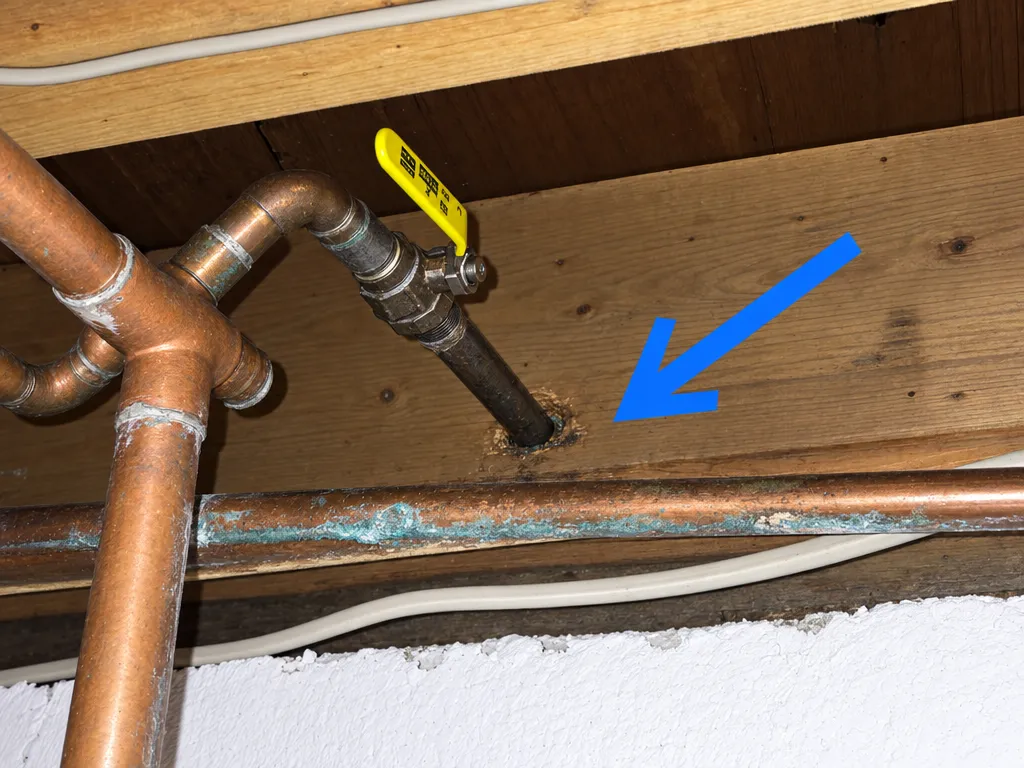
- Find the main water shut-off valve. It's usually in the basement or utility room, on the wall that faces the street.
- Look at the pipe just before the valve.
- Run four quick tests:
- Colour: lead is dull grey.
- Tap it: lead doesn't ring when you hit it.
- Scratch it gently with a key or coin: lead shows a shiny, silver mark.
- Try a magnet: a magnet won't stick to lead.
| Pipe material | Colour | Scratch test | Magnet |
|---|---|---|---|
| Lead | Dull grey | Shiny silver mark | Doesn't stick |
| Copper | Brown, like an old penny | Copper-coloured mark | Doesn't stick |
| Galvanized steel | Grey | Stays dull grey | Sticks |
Can't reach the pipe, or not sure what you're looking at? Ask a plumber. The City also has a short how-to video on the same page.
One catch. Even if the part you can see is copper, a section underground may still be lead. The only way to know for sure is to test the water.
Curious what else is in your water? Enter your postal code in Purely's free Water Report to see what's been found in your area.
Step 3: Get your water tested by the City
If your building has eight homes or fewer and was built before 1970, you can ask the City to test your tap water without waiting for a letter.
- How: fill in the City's request form (in French) and send it by email or mail to the Section Dépistage Plomb. The City then calls to book a visit.
- When: testing runs from June to October each year.
- What happens: a City worker, wearing official ID, measures lead in water from your kitchen tap with a portable tool. You get the result in writing.
- Cost: free.
The City notes that this test confirms whether there's lead in your water, but it isn't a formal lab analysis. If you want a lab result, for example before buying a home, you can use a lab accredited by Quebec's environment ministry.
If the result is positive
Every household in the building is told how to get a free filter pitcher with five filters. Delivery takes about eight weeks, and later filters are at your own cost. A second program offers a free pitcher to low-income households in buildings that may have lead pipes, if someone is pregnant or there's a child under 6. Call 311 to check.
Replacing the line
The City replaces the public part of the line, from the main to your property line, for free. Since 2021, under By-law 20-030, owners must also replace the private part, from the property line to the shut-off valve inside.
- If the City replaces the private part during its street work, it bills the owner. Its average estimate, based on 2022 to 2025 data, is $1,200 to $1,400 per metre, including fees.
- The bill comes the year after the work. You can pay it all at once or spread it over 15 years on your property taxes.
- You can also hire your own contractor first, through your borough's permit office, then tell the City what material you used.
- Once the City sends you a notice, you have 24 months to replace the private part. Owners who don't can be fined $500 to $2,000 as individuals, or $1,000 to $4,000 as companies.
- The RénoPlex program offers a $1,200 grant for the work when it's part of at least $3,000 in other eligible renovation grants.
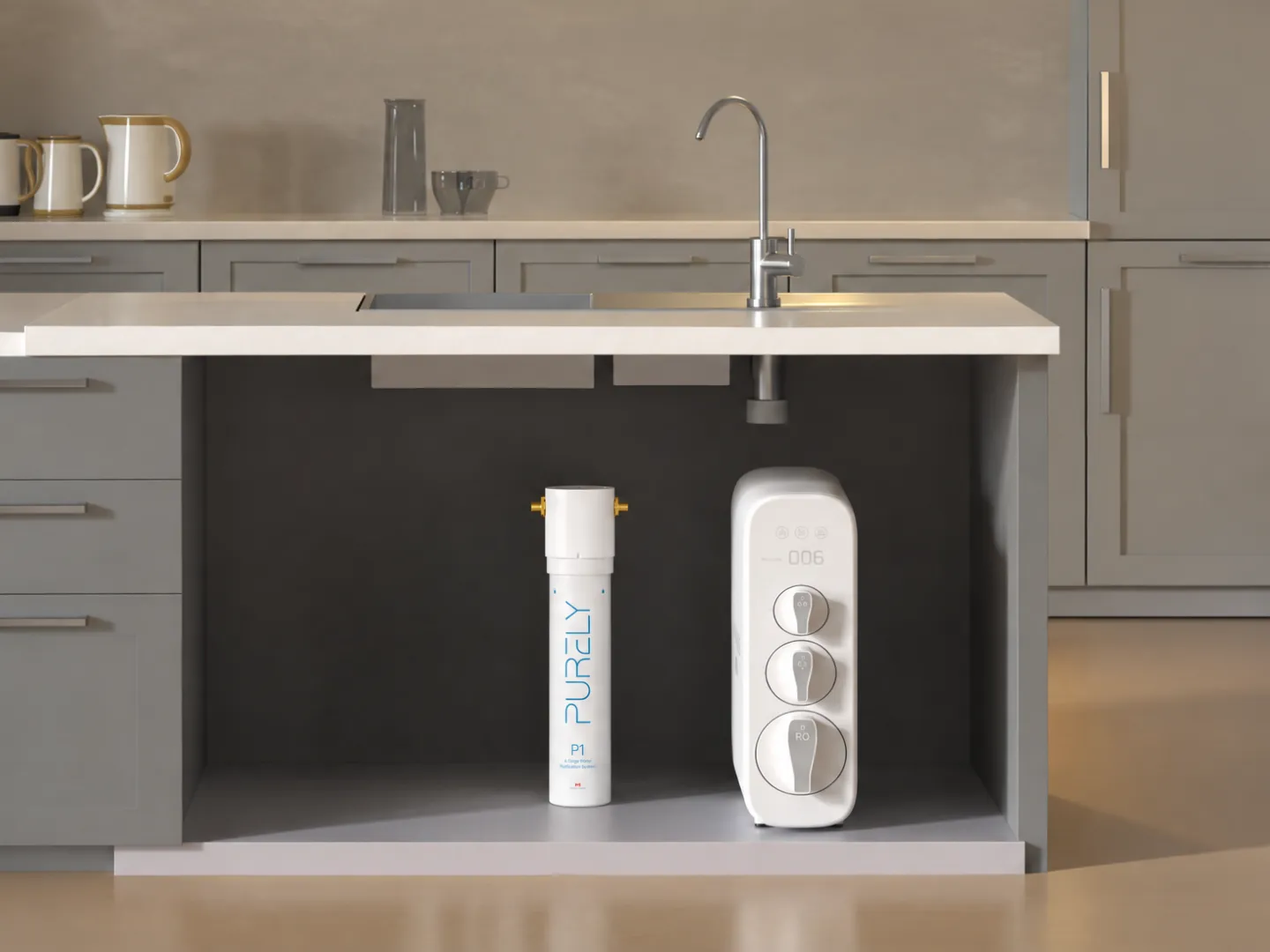
Waiting on a replacement? The P1 Under-Sink reduces lead and chlorine right at your kitchen tap. It installs in about 10 minutes, with no tools and no drilling. See how it works →
What to do in the meantime
Replacement can take a while. Until your whole line is replaced, the City's health advice comes down to two things: the right filter and a few daily habits.
Use a filter that reduces lead
The City recommends using a water filter until your whole service line, public and private, is replaced. Pick one made to reduce lead, not just chlorine taste. Ordinary granular carbon holds very little dissolved lead. And change the cartridge on time.
Purely's P1 Under-Sink is built for this. Its Nanofiber™ media is acid-treated activated carbon fibre, with negatively charged spots that grab positively charged lead. The P1 is designed to reduce up to 99% of contaminants, including lead, chlorine and chlorine byproducts, and each cartridge lasts up to 2 years or about 22,000 L. The Purely app tracks cartridge life, so you know when to replace it. Our guide to carbon vs reverse osmosis explains the science.
Build in a few habits
- Run the tap first. Let the cold water run a few minutes until it feels colder, especially in the morning or when you get home.
- Use cold water only for drinking and cooking, including coffee, tea, pasta, rice and vegetables.
- Clean your faucet aerator often. Small particles can collect in the screen.
- Don't count on boiling. Boiling doesn't remove lead.
- For babies, the INSPQ says to run the water until it's colder, then another minute or two, and never to use hot tap water for bottles.
After the line is replaced
Replacing the line removes the main source of lead. Old faucets and solder can still add a little, but much less. The City says running the tap until the water is cold is an easy way to handle what's left. For a broader look at your water, see our guide Is Montreal Tap Water Safe to Drink?
Frequently asked questions
How do I know if my Montreal home has lead pipes?
Check the City's online lead lookup tool, look at the pipe by your main shut-off valve, and ask for free testing if your building has eight homes or fewer and was built before 1970.
Does boiling water remove lead?
No. Lead doesn't evaporate, so boiling doesn't remove it.
Who pays to replace a lead service line in Montreal?
The City pays for the public part. The owner pays for the private part, either through their own contractor or through the City, which estimates an average of $1,200 to $1,400 per metre.
Does any water filter remove lead?
No. Many filters only target chlorine taste and smell. Pick one made to reduce lead, like one using acid-treated activated carbon fibre, and change the cartridge on time.
Do I have to replace my lead service line?
Yes. Since 2021, By-law 20-030 requires owners to replace the private part. Once the City sends you a notice, you have 24 months to do it, or you can be fined.
Should I have my child's blood lead tested?
Talk to your doctor or call Info-Santé at 811. They can advise you based on your child's age and your home.
Know your pipes, then your water
Checking for lead pipes is the most important water step you can take in an older Montreal home. Once you know where your building stands, the next question is what else is in your tap. Our fluoride guide explains why lead deserves more attention than the headlines suggest.
Purely's Water Report brings local water quality data into one place. Enter your postal code to see your area's Optimal Score and how each contaminant found compares with Quebec's limit.
Check your water quality now →
Waiting on a replacement, or living in an older building? Reduce lead and chlorine right at your kitchen tap.
Sources
- City of Montréal: Lead lookup tool
- City of Montréal: Map of lead service lines
- City of Montréal: How to recognize a lead water service line
- City of Montréal: Ask for your water service line to be screened for lead
- City of Montréal: Lead service lines, health recommendations
- City of Montréal: Remplacer son entrée d'eau en plomb, votre responsabilité
- City of Montréal: RénoPlex financial support
- CBC News: How Montreal is reducing lead exposure from water pipes (2019)
- City of Montréal: Drinking water quality annual reports
- Health Canada: Lead guideline technical document
- CTV News: Montreal lead pipe map