
They’ve found tiny bits of plastic in testicles, semen, ovaries and placentas. And in study after study, people carrying more plastic tend to have a harder time with fertility. Nobody has proven that plastic is the cause yet. But the pattern keeps showing up, and there’s a lot you can do about it, starting with the water you drink.
The short version
- Plastic production is up. Sperm counts and birth rates are down. The two trends mirror each other.
- Microplastics have been found in testicles, semen, ovaries and placentas.
- People with more plastic in their bodies tend to have lower sperm counts and less success with IVF.
- It isn’t proven that plastic is the cause. The evidence is early, but it keeps pointing the same way.
- For a typical adult, about 40% of the microplastics swallowed come from drinking water. The right water filter can cut that down.
More plastic, lower fertility
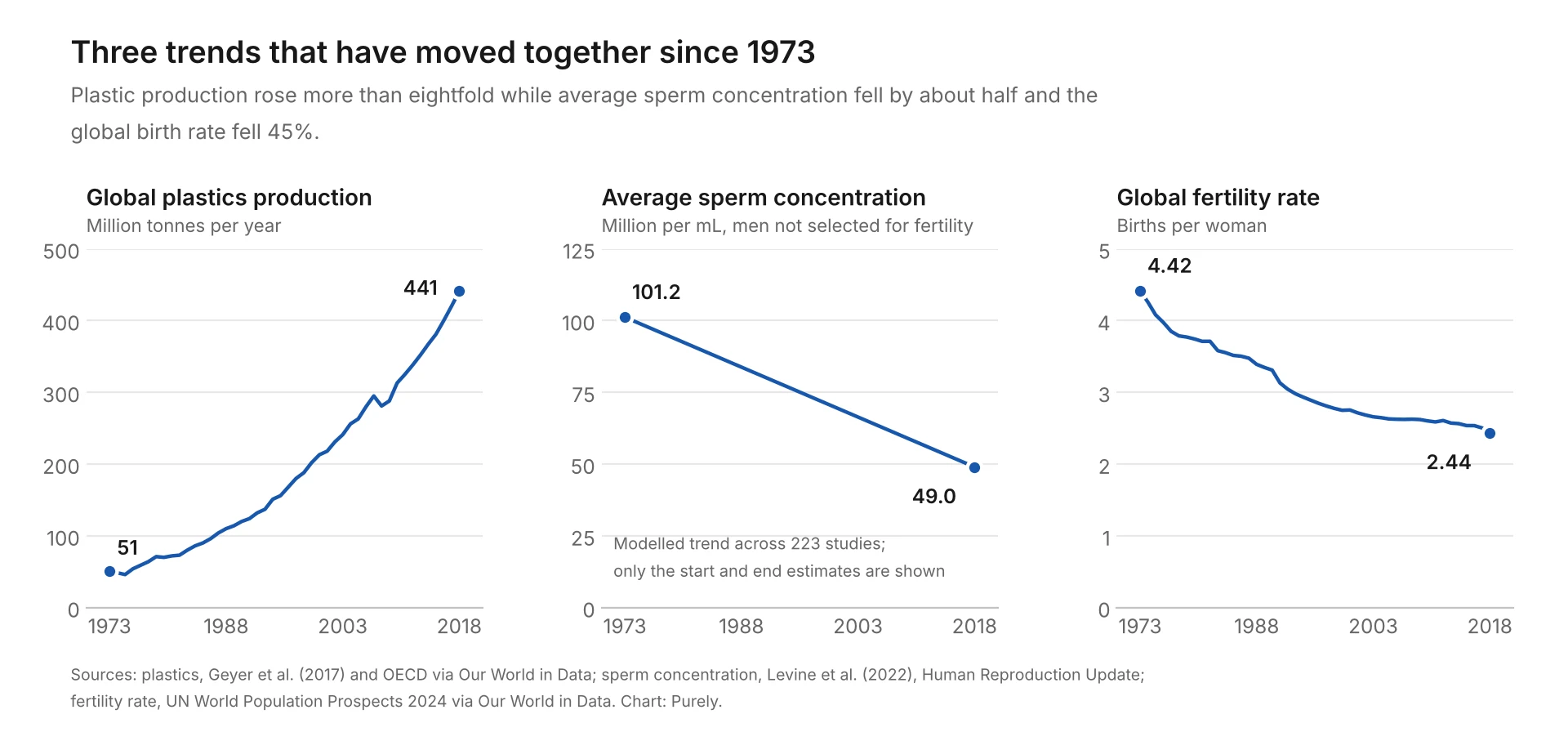
In 1950, the world made about 2 million tonnes of plastic a year. Today it’s about 460 million. Plastic doesn’t go away. It just breaks into smaller and smaller pieces, until they’re tiny enough to end up in our food, our air and our water.
Now look at what happened to fertility over the same stretch:
- Sperm counts fell by about half. The largest study of its kind pooled results from more than 57,000 men. It found that the average sperm count dropped 52% between 1973 and 2018. The lead researcher called it “a canary in a coal mine”.
- Birth rates fell by more than half. In 1950, women around the world had close to five children on average. Today it’s just over two. In Canada it’s 1.26, the lowest on record.
Line those trends up and they look like mirror images. As plastic went up, fertility went down, almost year for year. If you like numbers, the correlation is about -0.88, where -1 would be a perfect mirror. That’s our own calculation from public data.
Microplastics are showing up where life begins
For a long time, doctors assumed the reproductive organs were sealed off from this kind of thing. The testicles, for example, sit behind a tight natural barrier. So when a University of New Mexico team went looking for plastic in testicle tissue from 23 men, they didn’t expect to find much.
They found it in every single one.
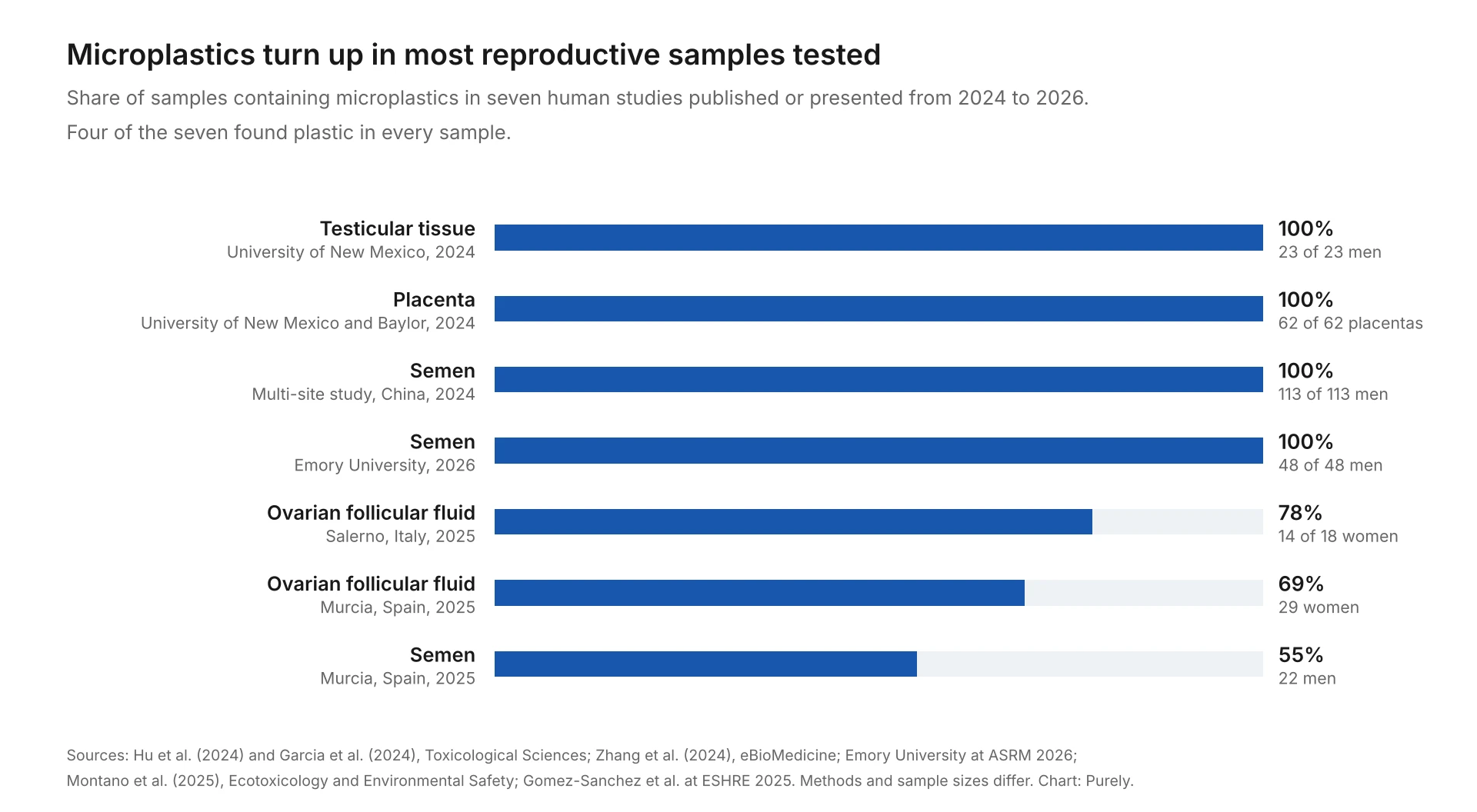
It wasn’t a one-off. Since then, plastic has been found in the semen of every man tested in two separate studies. It’s been found in the fluid that surrounds a woman’s eggs. And it turned up in all 62 placentas checked in another study. Different countries, different labs, different tools. Same result.
More plastic, more trouble
Finding plastic in the body is one thing. What really got researchers’ attention came next: the more plastic they found, the worse the fertility results tended to be. Three findings stand out.
The non-stick pan connection. In a study of 113 men in China, those with PTFE in their semen had lower sperm counts. PTFE is the plastic used in non-stick coatings. And the more types of plastic a man carried, the lower his count went.
IVF clinics are seeing it too. Three separate studies of women going through IVF found the same pattern. The more plastic in the fluid around their eggs, the fewer eggs fertilized or the poorer the results.
Even our dogs show it. Dogs share our homes, our air and often our water. In the New Mexico study, dogs with more PVC in their testicles had lower sperm counts.
How could plastic do this?
Scientists have a few ideas, and they aren’t far-fetched.
- It’s tiny enough to get in. The smallest pieces, called nanoplastics, are far smaller than a human cell. That lets them slip through the body’s natural barriers.
- It irritates the body. In animal studies, plastic particles cause inflammation and a kind of wear and tear on cells. A University of California review of that research concluded that microplastics are “suspected” of harming sperm quality.
- It carries chemicals that mess with hormones. Some chemicals used to soften plastic, called phthalates, already have solid evidence linking them to male fertility problems.
What we don’t know yet
Here’s the honest part. Nobody has proven that microplastics cause infertility in people.
The studies so far are small, and most are snapshots. They show that plastic and fertility problems tend to show up together. They can’t show that one causes the other. Measuring plastic inside the body is also tricky, so the exact amounts are still debated. And not every study agrees that sperm counts are falling. Bigger, longer studies are being planned.
It’s also worth knowing that plastic isn’t the only thing pushing birth rates down. People are simply having kids later.
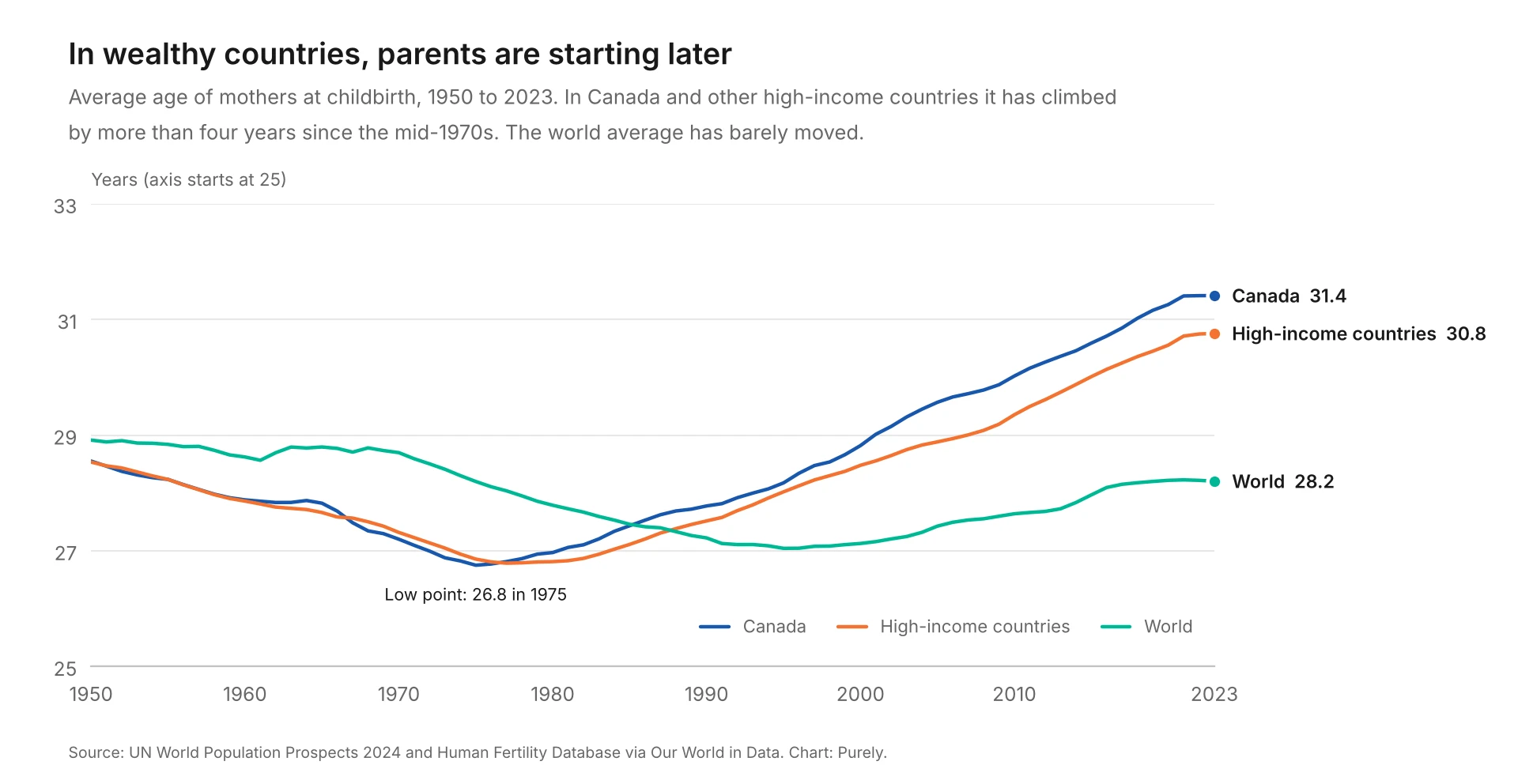
In Canada, the average mom is now almost 32 when she gives birth. In 1976, she was under 27. That matters, because a woman’s fertility starts to dip at around 32. Money plays a part too. When the UN asked people in 14 countries what was getting in the way of the family they wanted, money came up about three times as often as infertility.
So plastic is likely one piece of a bigger puzzle. It’s also one of the few pieces you can do something about at home.
You don’t have to wait for proof
You don’t need a final verdict to cut back on something that’s easy to cut back on. The World Health Organization takes the same view: reduce your exposure while science catches up.
So where does it all come from?
How much comes from your drinking water?
More than you’d think.
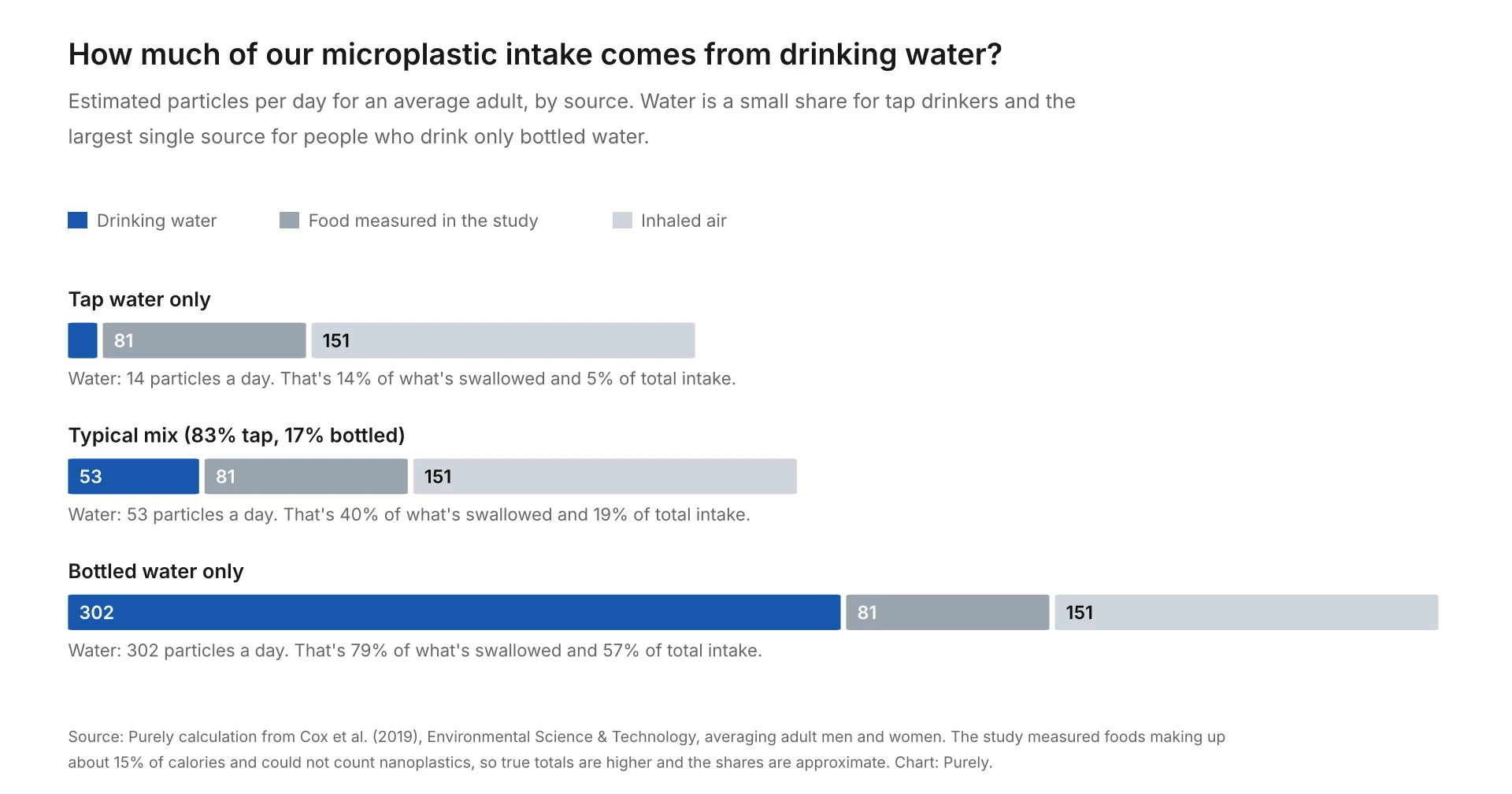
Using figures from a well-known University of Victoria study, we worked out how much of the plastic a typical adult swallows comes from water:
| What you drink | Share of swallowed microplastics that comes from water |
|---|---|
| Tap water only | About 14% |
| A mix of tap and bottled | About 40% |
| Bottled water only | About 79% |
Bottled water is the worst offender by far. The study estimated that people who drink only bottled water swallow about 90,000 extra plastic particles a year. For tap water drinkers, it’s about 4,000.
These are rough numbers. The study couldn’t count the very smallest particles, so the real totals are likely higher. But the message holds: the microplastics in your drinking water are a big part of what you take in, and they’re the easiest part to change.
Do water filters remove microplastics?
Some do and some don’t, so it pays to check. A water filter for microplastics should come with three things:
- Proof. Look for published test results for fine particles. Many popular water pitcher filters and fridge water filters don’t have any.
- A filter that doesn’t shed. Some filters can release particles of their own.
- Easy upkeep. A filter only works if you change it on time.
For most homes, the simplest setup is filtered water straight from the kitchen tap. That’s the tap you drink and cook from, and it means no more plastic bottles. Want help choosing? Our guides to the best home water filtration system and what makes a good water filter compare the options.
Two more easy wins while you’re at it: don’t heat food in plastic, and vacuum often, since house dust carries plastic too. Our microplastics and nanoplastics guide has the full list.
Where the P1 fits
The P1 is Purely’s under sink water filter. It connects to your kitchen tap, so the water you drink and cook with is filtered before it reaches your glass.
Our test results show it reduces more than 99% of particles between 0.5 and 1 micrometre. That’s roughly 100 times thinner than a human hair, and it’s the finest particle class in the NSF/ANSI 42 filter standard.
It also reduces chlorine and lead, keeps the healthy minerals in your water, and it’s built to keep your water pressure strong. It installs in under 10 minutes, and one cartridge lasts up to 2 years.
One thing we want to be clear about: a filter isn’t a fertility treatment, and we’d never call it one. It simply means less plastic in the water your family drinks every day.
Frequently asked questions
Do microplastics cause infertility?
It hasn’t been proven. What studies do show is that microplastics reach the reproductive organs, and that people with more plastic tend to have lower sperm counts and less success with IVF. Bigger studies are being planned.
Have microplastics been found in testicles and ovaries?
Yes. Researchers have found them in testicles, semen, the fluid around a woman’s eggs and placentas.
How much of our microplastic intake comes from drinking water?
By our calculation, about 40% of what a typical adult swallows. If you drink only bottled water, it’s closer to 80%.
Is bottled water or tap water worse for microplastics?
Bottled water. One study estimated about 90,000 extra particles a year from bottled water, compared with about 4,000 from tap.
Do water filters remove microplastics?
Some do. Check for published test results for fine particles before you buy. Many pitcher and fridge filters don’t have any.
What’s the best water filter for microplastics?
One that’s been tested for fine particles, doesn’t shed particles of its own and is easy to keep up with. For most homes, that’s a filter on the kitchen tap, where your drinking and cooking water comes from.
Optimal, not just acceptable
We may not have the final answer on microplastics and fertility for years. But you don’t need it to make a simple choice today. Less plastic in your family’s water is better than more. That’s the difference between acceptable and optimal.
This article is for general information. It isn’t medical advice. If you have concerns about fertility, please speak with a doctor.
Filtered water at your kitchen tap, for up to 2 years per cartridge:
Explore the P1 under sink water filter →
Want to know what else is in your water?