But a fridge filter is a small cartridge working under tight limits. It has to fit inside a refrigerator, push water through fast enough to fill a glass, and last about six months. Most are built first for better tasting water and clearer ice. Whether yours does more depends on which cartridge is installed, whether it's genuine and how recently it was changed. And new research on what happens to water after the filter, as it travels through the fridge's tubing and reservoir, raises questions most owners have never thought to ask.
This guide covers what a fridge filter is built to remove, what it often misses, the counterfeit problem, what can grow inside a dispenser, the real cost of keeping one current and what a more complete setup looks like.
What a fridge water filter is built to do
Fridge filters are certified against the same NSF/ANSI standards as other home filters. NSF/ANSI 42 covers aesthetic issues like chlorine taste and odour. NSF/ANSI 53 covers health-related contaminants such as lead. NSF/ANSI 401 covers a set of emerging contaminants, including some pharmaceuticals. A filter only does what it's certified for, and certifications vary widely from one cartridge to the next. (We explain why even a "certified" taste and odour filter sets a lower bar than most people assume in our guide to water pitcher filters.)
The better name-brand cartridges cover a lot. Whirlpool's EveryDrop Filter 1, for example, is NSF certified to reduce lead, pesticides and pharmaceuticals and is meant to be replaced every 6 months or 200 gallons, about 757 litres.
Cheaper replacements are a different story. In its first test of refrigerator water filters, published in April 2026, Consumer Reports evaluated 29 filters for fridges from more than a dozen brands. It noted that many third-party filters are certified only to NSF/ANSI 42, the chlorine taste and odour standard. And when it comes to PFAS, only GE's filters were certified to reduce PFOA and PFOS.
The fair takeaway: "fridge filter" isn't one thing. It ranges from a basic taste cartridge to a well-certified one, and the label on the cartridge in your fridge, not the brand on the door, decides what you're actually getting.
What slips past the fridge filter
PFAS: inconsistent at best
PFAS are thousands of human-made "forever chemicals" used in non-stick coatings, stain-resistant fabrics, food packaging and firefighting foam. Conventional treatment plants weren't built to remove them. Health Canada set an objective of 30 ng/L for 25 PFAS in 2024, but PFAS aren't routinely monitored at most Canadian plants. Our guide to fluoride, lead and PFAS covers the regulatory picture.
The best-known study on home filters and PFAS started with a fridge. Duke University researcher Heather Stapleton says the work was prompted partly by curiosity about the refrigerator filter in her own home after her tap water tested higher than she expected. Her team and NC State researchers tested 76 point-of-use filters in real homes. Activated carbon filters like those in refrigerators and pitchers removed 73% of PFAS on average, but results ranged from complete removal to no reduction at all. Shorter-chain PFAS, the newer compounds that replaced phased-out ones, were reduced by only about 40%.
The researchers also found that saturated filters that aren't replaced can release PFAS they've already captured back into the water. A fridge filter past its prime isn't neutral.
Lead: fine if it's certified, and if it's real
Lead almost never comes from the treatment plant. It dissolves into water on the way to your tap, from old lead service lines, lead solder and older brass fixtures. In Montreal, buildings with eight or fewer units built before 1970 are the most likely to have lead service lines. Health Canada's limit is 0.005 mg/L, and it says no level of lead exposure has been shown to be free of health effects.
A genuine fridge filter certified to NSF/ANSI 53 for lead can do real work here. A cartridge certified only for taste and odour isn't designed to. And as the next section shows, the cartridge in your fridge may not be the one it claims to be.
Microplastics: read the fine print
Canada has no drinking water guideline for microplastics yet, and research into their health effects is moving quickly. Some fridge filters list microplastic reduction in their performance data and many don't. A filter certified only to NSF/ANSI 42 makes no claim at all. If microplastics are part of why you filter, check the performance data sheet for your exact cartridge rather than assuming.
The counterfeit problem no one mentions at the dispenser
Fridge filters have a problem pitchers and under-sink systems rarely face at the same scale: fakes. At $45 to $60 a cartridge, plenty of owners go looking online for a cheaper replacement, and counterfeiters are waiting for them.
The appliance industry takes this seriously enough to run a public campaign about it. When the Association of Home Appliance Manufacturers (AHAM) had counterfeit refrigerator filters tested against the same standards genuine filters must meet, only two of 18 filters reduced lead for the full six-month life of a fridge filter. In a broader round of testing with independent labs, nearly 100 counterfeit filters failed to remove lead and live cysts, and more than 10 cancer-causing chemicals were found leaching into the water. Investigators opening fakes found burnt peanut shells where a carbon block should be, and rocks added to match the weight of the real thing.
These aren't rare. Over roughly one year, US Customs officers at the Los Angeles and Long Beach seaport alone seized 169,490 counterfeit water filters, fridge replacements among them. One shipment of more than 5,200 fake fridge filters even carried counterfeit NSF certification marks. Consumer Reports warns that fake logos and certification badges are common on filters sold through third-party marketplace sellers.
How to protect yourself:
- Buy from the fridge manufacturer or an authorized retailer, not a third-party marketplace seller.
- Be wary of prices far below the name-brand cartridge.
- Treat a filter that feels noticeably light as a red flag. Counterfeits tend to weigh less than the real thing.
- Look up the certification on NSF's website, not just the box.
The water from a counterfeit can look, smell and taste fine. That's what makes it dangerous.
What can grow inside your fridge dispenser
This is the part most fridge owners have never heard about.
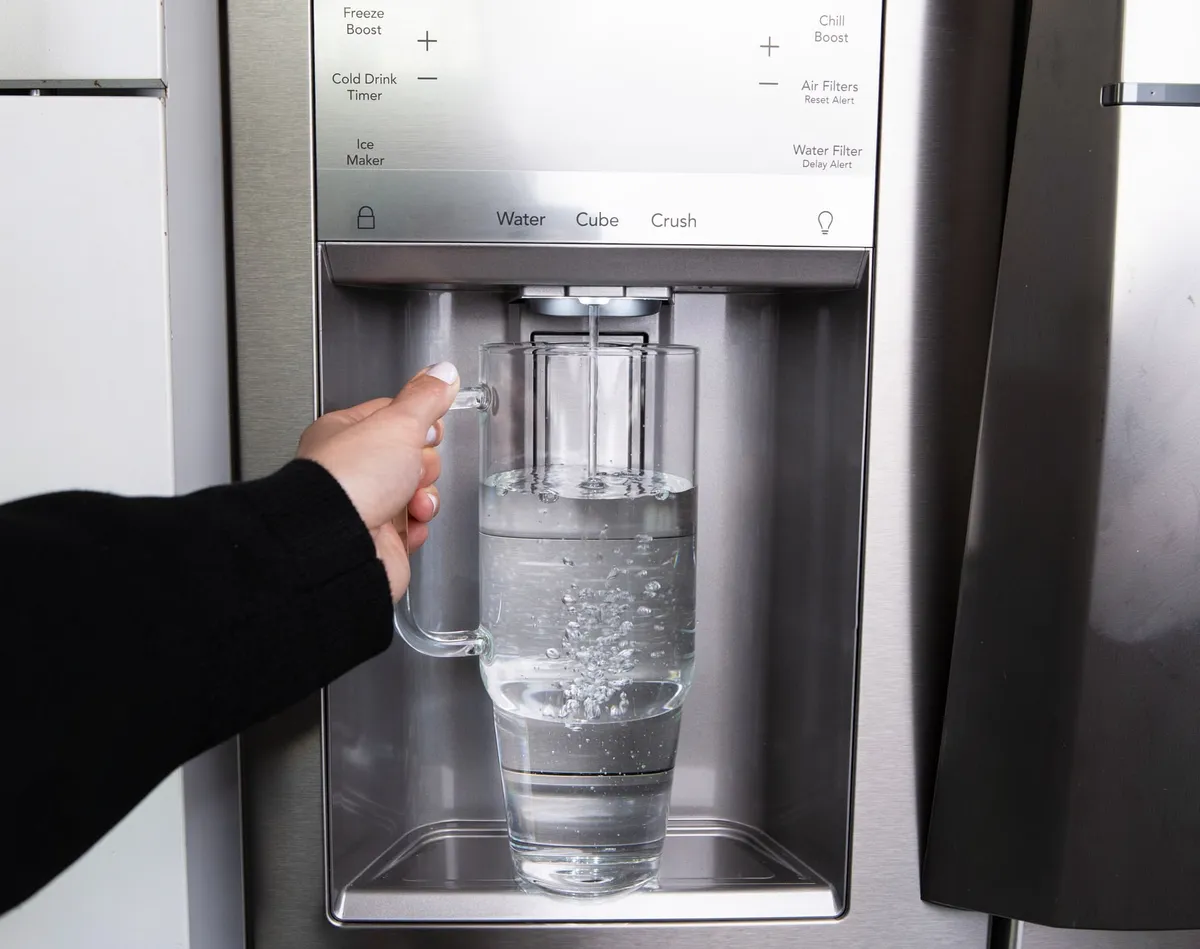
A carbon filter removes chlorine. That's why the water tastes better, but chlorine is also what keeps bacteria in check on the way to your tap. In a fridge, filtered water doesn't go straight to your glass. It travels through tubing and often sits in a reservoir, sometimes for hours or days between uses.
University of Tennessee researchers looked at what that does to the water. In a study published in 2024 in the American Journal of Infection Control, they found that passing through in-fridge dispensing systems led to significant microbial growth. Potential opportunistic pathogens increased sharply: Mycobacterium by about 8,053-fold and Pseudomonas by about 221-fold. The researchers linked the increase to the loss of the disinfectant residual.
The outside of the dispenser isn't much better. When NSF International swabbed 14 common kitchen items in 20 family homes, the refrigerator water dispenser ranked as the germiest, ahead of rubber spatulas and blender gaskets. Volunteers had expected the microwave keypad to top the list.
Some fair context: opportunistic pathogens are mainly a concern for people with weakened immune systems, and most healthy adults won't get sick from dispenser water. But a filtered water source that adds bacteria on its way to the glass is not what most people think they're paying for.
Simple steps if you use your dispenser:
- Don't press water bottles or cups against the nozzle.
- Clean and sanitize the nozzle and drip area regularly.
- After a trip, run the dispenser for a minute before drinking.
- Follow your manufacturer's instructions for sanitizing the water system.
The replacement treadmill
Name-brand fridge cartridges typically cost about $45 to $60 in Canada. LG's replacement filters, for example, sell for $43.98 to $54.98 at Home Depot Canada, with a change recommended every six months.
Most cartridges are rated for about 200 gallons, or 757 litres. Spread over six months, that's only about 4 litres a day. Here's what that looks like in practice:
- On the manufacturer's schedule: 2 filters a year, roughly $90 to $120 a year or $180 to $240 over two years. That only covers about 4 litres of filtered water a day.
- For a household that drinks and cooks with filtered water (about 8 litres a day): a cartridge runs out in about three months. That's 4 filters a year, roughly $180 to $240 a year, or $360 to $480 over two years.
And it's easy to fall behind. According to Consumer Reports, LG, GE and Whirlpool refrigerators work fine without a filter, so the water keeps flowing whether the cartridge is fresh, exhausted or missing entirely. Nothing about the glass tells you the filter stopped working months ago.
The trickle
Then there's the speed. Water filters are often the single biggest flow restriction in a fridge's water system, and fridge filters are typically certified at a service flow rate of half a gallon per minute, about 1.9 litres a minute. Running water through faster can void the filter's contaminant claims.
As a cartridge loads up, flow drops further. In its 2026 testing, Consumer Reports counted a filter as still useful as long as it delivered at least 2 cups a minute. At that rate, filling a 6 litre pasta pot would take about 13 minutes, if the pot fit under the dispenser at all.
So people don't. When it's time to boil pasta, fill the kettle or rinse vegetables, they turn to the sink, and the sink isn't filtered.
Where your filtered water stops
To be fair to the fridge, it does one thing well: it feeds your ice maker, so every cube is made from filtered water. That's a real advantage over a pitcher.
But the fridge usually sits across the kitchen from the sink and the stove, and that's where most of your water use happens:
- Cooking. Pasta, rice, oats and beans absorb the water they're cooked in. Soups and stocks are mostly water.
- Coffee and tea. The kettle and coffee maker get filled at the sink.
- Baby formula. Usually mixed with water from the kettle or the tap.
- Washing produce. Berries and greens get rinsed under the faucet.
- Pets. The water bowl gets topped up at the sink.
A fridge filter covers the glass you hold under the door. Everything else in your kitchen still runs on tap water.
Fridge water filter vs under-sink filtration at a glance
| Name-brand fridge filter | Low-cost third-party filter | Purely P1 under-sink | |
|---|---|---|---|
| Chlorine | Yes | Yes | Yes |
| Lead | Many models certified; check yours | Often not certified | Yes |
| PFAS | Only GE certified for PFOA and PFOS | Usually not claimed | Yes |
| Microplastics | Varies by model | Usually not claimed | Yes |
| Counterfeit risk | Real when bought online | Real when bought online | Replacements ordered direct from Purely |
| Filter life | About 757 L or 6 months | About 757 L or 6 months | Up to 2 years or 20,000 L |
| Replacements in 2 years (8 L a day) | About 8 | About 8 | 1 |
| Filter cost over 2 years (8 L a day) | About $360 to $480 | Lower per filter | $260, system included |
| Flow | About 1.9 L a minute, slowing with use | About 1.9 L a minute, slowing with use | About 7.5 L a minute, on demand |
| Covers cooking, coffee, formula, produce | Only if it fits under the door | Only if it fits under the door | Yes, straight from the tap |
A better way: the P1 Under-Sink System with Nanofiber+™ technology
If the fridge filter's weak points are what it covers, what it costs to keep current and where it sits in your kitchen, the answer is filtration at the tap you actually use the most.
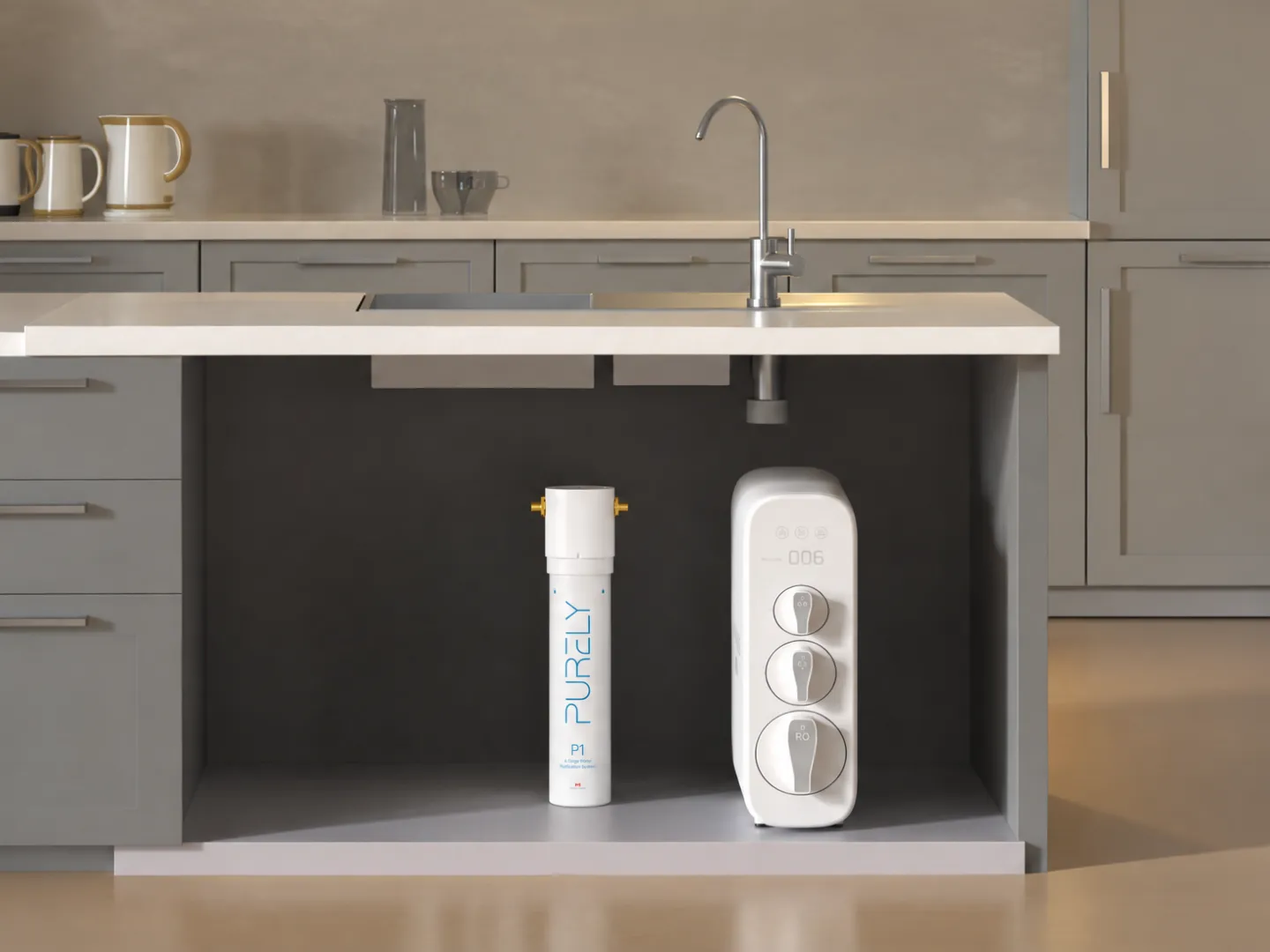
Purely's P1 Under-Sink System is built around NanoFiber™ Media. Instead of the compressed carbon block found in most fridge cartridges, it uses activated carbon fibres, enhanced through oxygen infusion, that create more active sites for contaminants to bind to. That's what lets it reduce heavy metals like lead that ordinary activated carbon struggles with, along with chlorine and the chemical contaminants fridge filters handle inconsistently.
Water moves through four stages:
- Sediment pre-filter catches rust, sand and particles before they reach the finer media.
- NanoFiber™ Media reduces chlorine, chlorination byproducts, VOCs, heavy metals including lead, PFAS, microplastics and pharmaceuticals.
- Silver-Core™ is designed to prevent bacterial growth inside the filter, the weak spot of carbon filtration.
- Activated Alumina targets fluoride and arsenic.
Altogether, the P1 is designed to reduce up to 99% of 100+ common tap water contaminants, while keeping naturally occurring minerals like calcium and magnesium in your water. And filtered water goes from the cartridge to your faucet on demand. There's no reservoir or long run of tubing inside a fridge door between the filter and your glass.
Less than you're already spending
The P1 is $260, and a single cartridge lasts up to 2 years or 20,000 litres. To filter that same 20,000 litres with fridge cartridges, you'd go through about 26 of them. For a household using 8 litres a day, two years of fridge filters runs $360 to $480. The P1 costs less over the same period and filters every drop that comes out of your main tap.
One cartridge, one source you can trust
No hunting for the right part number, no wondering whether a marketplace listing is genuine. When it's time, the cartridge twists off and a new one twists on, with no tools and no mess. The Purely app tracks your usage in real time and tells you when a replacement is due, so you're never running an exhausted filter without knowing it.
Full flow, no waiting
The P1 delivers filtered water at roughly 7.5 litres a minute, about four times the rated flow of a typical fridge filter. A 6 litre pot fills in under a minute, right where you cook.
It installs in under 10 minutes with no plumber, and it's backed by a 30-day money-back guarantee and a 5-year warranty.
Keep the fridge for ice
You don't have to give up your dispenser. Keep a genuine, current cartridge in the fridge for ice and a cold glass, and let the P1 handle everything that happens at the sink: the pasta water, the morning coffee, the formula and the rinse of the berries.
Want to go further? The P1+ 2-Stage Defender is installed at your main water line, so every tap, shower and appliance in your home gets filtered water. It's how you extend the same standard to your skin and hair and even your laundry.
Frequently asked questions
Do fridge water filters remove PFAS?
Inconsistently. In a Duke University and NC State study, activated carbon filters like those in refrigerators removed about 73% of PFAS on average, with results ranging from complete removal to none. Consumer Reports found that only GE's fridge filters are certified to reduce PFOA and PFOS.
Does a fridge filter remove lead?
Only if that specific cartridge is certified for lead under NSF/ANSI 53, and only if it's genuine. Many low-cost replacements are certified only for chlorine taste and odour, and counterfeit filters have repeatedly failed lead testing.
How often should I change my fridge water filter?
Every six months or at its rated capacity, usually about 757 litres, whichever comes first. A household that also cooks with fridge water can reach that limit in about three months. An overused filter can release contaminants it has already captured.
How can I tell if my fridge filter is counterfeit?
It's hard by sight alone. Buy from the fridge manufacturer or an authorized retailer, be cautious of unusually low prices and third-party marketplace sellers, and look up the certification on NSF's website. A filter that feels lighter than expected is a warning sign.
Is water from a fridge dispenser safe to drink?
For most healthy people, yes. But research has found that bacteria, including opportunistic pathogens, can multiply inside fridge dispensing systems once the filter removes chlorine. Keep the nozzle clean, change the filter on time and flush the line after a trip.
Is an under-sink filter better than a fridge filter?
For most homes, yes. An under-sink system filters water at full flow at your main tap, lasts far longer between cartridges, avoids the counterfeit problem and covers cooking, coffee and formula, not just the glass under the fridge door.
Upgrade the water your kitchen runs on
A fridge filter shows you care about the water you drink. But a cartridge you can't verify, a dispenser that can add bacteria and a trickle that sends you back to the tap add up to "better than nothing," not "optimal." You don't exercise only because inactivity is illegal. Your water deserves the same standard: not just improved, but optimal.
Filtered water at your kitchen tap, for up to 2 years per cartridge:
Explore the P1 Under-Sink System →
Not sure what's in your water?