The research tells a more complicated story. Many standard pitcher filters aren't designed to reduce lead, PFAS or microplastics at all. Even the upgraded ones leave gaps, and their performance depends on a replacement schedule most households struggle to keep. This guide covers what a pitcher actually removes, what slips past it, why those contaminants are in your water in the first place, and what a more complete setup looks like.
What a water pitcher filter is built to do
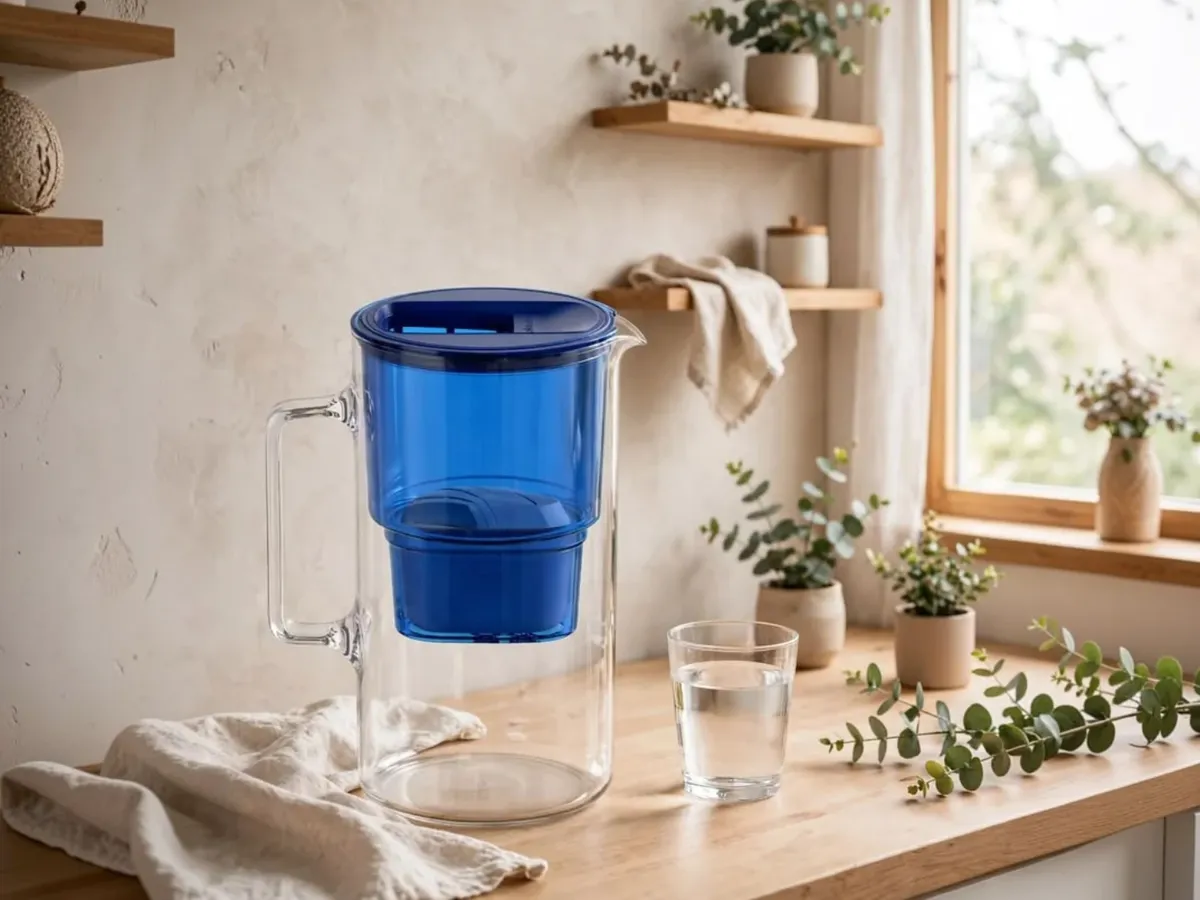
Start with the box. In Canada, Brita says its standard pitcher filters reduce chlorine taste and odour, copper, mercury and cadmium, and should be replaced every two months or 151 litres. That's a useful list. It's also a short one.
Notice what isn't on it. Lead isn't listed. A Michigan public health guide to using Brita pitchers states it plainly: standard filters are not certified to remove lead.
Upgraded pitcher filters do better. Brita's Longlast+ filter, for example, is certified to reduce lead along with chlorine, mercury, cadmium, asbestos and benzene, and its performance data sheet shows over 99% lead reduction in testing. But PFAS and microplastics aren't on that list either. And as you'll see below, lab results under controlled conditions don't always hold up in real kitchens.
The fair takeaway: a pitcher filter is mainly a taste and odour device. Some models add lead reduction. Very few are built for the contaminants people worry about most today.
What slips past the pitcher
Lead: the contaminant with no safe level
Health Canada cut its limit for lead in drinking water in half in 2019, to 0.005 mg/L, and says science hasn't found any level of lead exposure that's free of health effects. The effect it's most concerned about is reduced IQ in children.
Why lead is in your water in the first place: it almost never comes from the treatment plant. Lead dissolves into water on its way to your tap, from old lead service lines, lead solder in copper pipes and older brass fixtures. In Montreal, buildings with eight or fewer units built before 1970 are the most likely to have lead service lines. Water that sits in those pipes overnight picks up more. We cover the full picture, including how to check your address on the city's lead map, in our guide to fluoride, lead and PFAS.
If your pitcher uses a standard filter, it isn't designed to address any of that. And even lead-certified pitchers have limits. When Virginia Tech researchers stress-tested 10 lead-certified pitcher and faucet filters, most performed very well. But in water containing colloidal lead (tiny lead particles rather than dissolved lead), up to 50% of the lead passed straight through some filters that would have passed certification testing. They also found premature clogging, leaking units and one filter with a hole in its media.
Iron is another real-world complication. A study of lead-certified pitcher filters found that at just 0.3 mg/L of iron, half the filters tested clogged prematurely, between 38% and 68% of their rated capacity. A clogged filter means more frequent replacements, or a household that gives up and pours from the tap.
PFAS: the forever chemicals carbon pitchers catch inconsistently
PFAS are thousands of human-made chemicals used in non-stick coatings, stain-resistant fabrics, food packaging and firefighting foam. They enter water sources through industrial discharge and everyday products, and conventional treatment plants weren't designed to remove them. Health Canada set a drinking water objective of 30 ng/L for 25 PFAS in 2024, but PFAS aren't routinely monitored at most Canadian plants, so many households have no idea what their levels are.
Duke University and NC State researchers tested 76 point-of-use filters in real homes. Activated carbon filters, the type used in most pitchers, removed 73% of PFAS on average. But results ranged from complete removal to no reduction at all. Lead researcher Heather Stapleton described the carbon filters in pitcher, countertop, fridge and faucet-mounted styles as inconsistent and unpredictable.
The study also flagged a maintenance risk that applies to any filter. The researchers believe filters that get saturated and aren't replaced can release PFAS they've already captured back into the water. A filter past its prime isn't neutral. It can make things worse.
Microplastics: some pitchers remove them, one added them
Microplastics come from plastic breaking down in the environment, plus packaging and synthetic fibres. Canada has no drinking water guideline for them yet, but research into their health effects is moving quickly.
Pitchers handle them very unevenly. When ConsumerLab tested popular pitchers using tap water containing 33.5 microplastic particles per litre, one filter removed all detectable particles, while two others cut them by 80% and 36%. One pitcher increased microplastics to 437 particles per litre, a 1,206% jump, and still added plastic after extra flushing. Several pitchers also released large amounts of carbon particles into the water.
Bacteria: what a countertop filter can grow
Carbon removes chlorine, the disinfectant that keeps bacteria in check. That's good for taste, but it means the filter itself can become a place for bacteria to settle. A German study from the 1990s found bacterial counts rose in the filtered water from 24 of 34 household pitcher filters, in some cases to 10,000 times the level in tap water. Pitchers have improved since then, and most of these bacteria aren't harmful to healthy people. But a damp filter sitting in a pitcher for weeks is a reason replacement schedules matter.
Even at its own job, the pitcher has a catch
Chlorine reduction is what pitchers do best. But the bar for "certified" is lower than most people assume. The NSF/ANSI 42 standard, which covers chlorine taste and odour, requires at least a 50% reduction across the filter's rated life. One certified generic pitcher's data sheet shows a minimum reduction of about 55%. Many filters perform far better than that when new, but carbon has a finite capacity. As it fills up, performance drops, and the only fix is a fresh cartridge.
That's where the real cost of a pitcher shows up.
The replacement treadmill
A standard pitcher filter is rated for 151 litres. Brita's own two-month estimate is based on about 11 glasses a day. That's a modest number for a family that also cooks, makes coffee and fills water bottles.
Run the numbers for a household that drinks and cooks with about 8 litres of filtered water a day:
- Standard filters (151 L): about 19 replacements a year. At $8 to $10 a filter, that's roughly $155 to $195 a year, or $310 to $390 over two years.
- Longlast+ filters (454 L): about 6 or 7 replacements a year. At around $30 a filter, that's about $190 a year. Brita's own data sheet also says that for maximum efficiency, you should process no more than 7.5 litres a day through it.
And that's if you replace on schedule. Consumer Reports found that clogging alone can swing yearly pitcher filter costs from $27 to $150. Every replacement is one more reminder to track, one more order to place and one more cartridge in the landfill. Most people stretch it. The result is a filter running well past the point where it does what the box says.
The trickle
Then there's the wait. Pitchers rely on gravity, and gravity is slow. In Consumer Reports testing, one pitcher filtered a quart in about 75 seconds while another took nearly 15 minutes. Slow flow also gets worse as a filter clogs.
The real cost of slow filtering isn't the minutes. It's what people do instead. When the pitcher is empty and you need to boil pasta, fill the kettle or make a bottle, you reach for the unfiltered tap.
Where your filtered water stops
Think about how much tap water ends up in your body without ever touching the pitcher:
- Cooking. Pasta, rice, oats and beans absorb the water they cook in. Soups, stocks and sauces are mostly water.
- Coffee and tea. Your kettle, espresso machine or coffee maker is probably filled straight from the tap.
- Baby formula. For families with infants, it's one of the most important uses of all.
- Washing produce. Fruit and vegetables get rinsed under the tap, not with pitcher water.
- Ice. Ice trays and fridge ice makers usually run on unfiltered water.
- Pets. The water bowl gets refilled from the faucet.
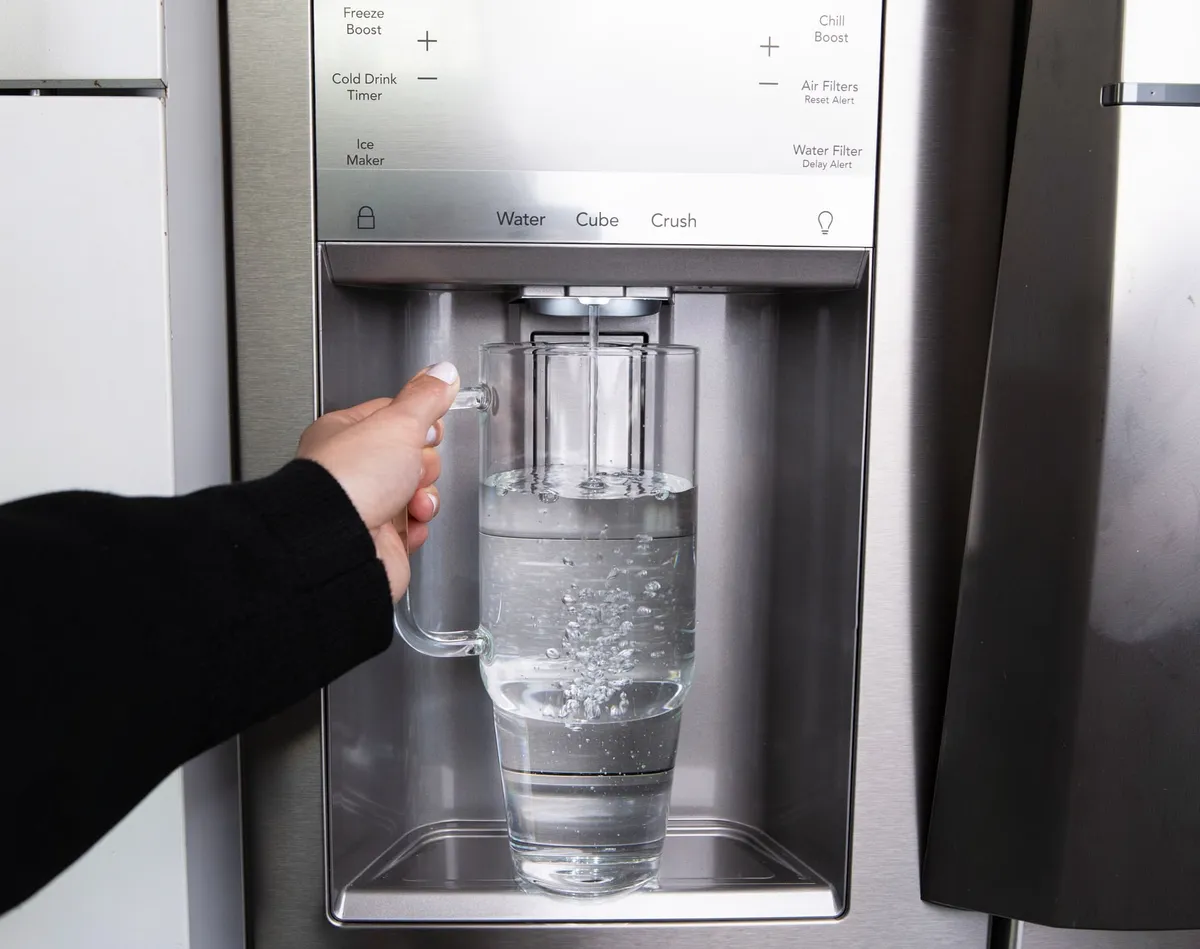
A pitcher covers the glass you pour from it. Everything else in your kitchen still runs on tap water.
Water pitcher filter vs under-sink filtration at a glance
| Standard pitcher filter | Upgraded pitcher filter | Purely P1 under-sink | |
|---|---|---|---|
| Chlorine | Yes | Yes | Yes |
| Lead | Not certified | Yes | Yes |
| PFAS | Not claimed | Not claimed | Yes |
| Microplastics | Not claimed | Not claimed | Yes |
| Filter life | 151 L, about 2 months | 454 L, about 6 months | Up to 2 years or 20,000 L |
| Replacements in 2 years (8 L a day) | About 39 | About 13 | 1 |
| Flow | Gravity trickle | Gravity trickle | About 7.5 L a minute, on demand |
| Covers cooking, coffee, formula, ice | Only if you wait | Only if you wait | Yes, straight from the tap |
A better way: the P1 Under-Sink System with Nanofiber+™ technology
If the pitcher's weak points are coverage, capacity and convenience, the fix is filtration that lives where you already use water: your kitchen tap.
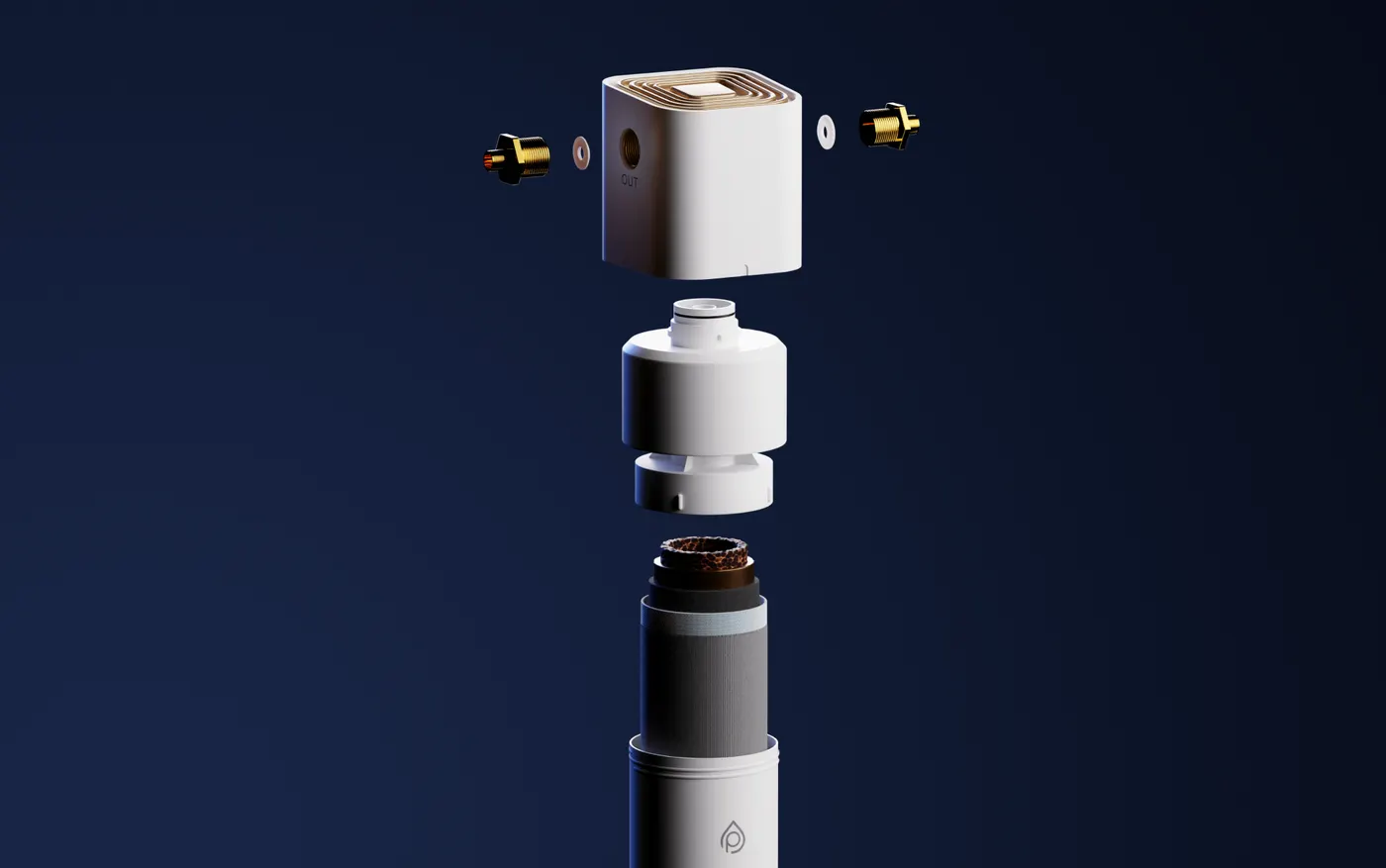
Purely's P1 Under-Sink System is built around NanoFiber™ Media. Instead of the loose carbon granules found in most pitchers, it uses activated carbon fibres, enhanced through oxygen infusion, that create more active sites for contaminants to bind to. That's what lets it reduce heavy metals like lead that ordinary activated carbon struggles with, alongside the chlorine pitchers are built for.
Water moves through four stages:
- Sediment pre-filter catches rust, sand and particles before they reach the finer media.
- NanoFiber™ Media reduces chlorine, chlorination byproducts, VOCs, heavy metals including lead, PFAS, microplastics and pharmaceuticals.
- Silver-Core™ is designed to prevent bacterial growth inside the filter, the issue carbon filters are known for.
- Activated Alumina targets fluoride and arsenic.
Altogether, the P1 is designed to reduce up to 99% of 100+ common tap water contaminants, while keeping naturally occurring minerals like calcium and magnesium in your water.
More cost-effective than it looks
The P1 is $260, and a single cartridge lasts up to 2 years or 20,000 litres. To filter that same 20,000 litres with a standard pitcher, you'd go through about 130 filters. Even at 8 litres a day, a household uses less than a third of the cartridge's rated capacity in two years. Compared with $310 to $390 in standard pitcher filters over the same period, the P1 pays for itself while doing far more.
Low maintenance
One cartridge every two years instead of one every two months. When it's time, the cartridge twists off and a new one twists on. No tools, no mess. The Purely app tracks your usage in real time and tells you when a replacement is due, so you never end up running a filter past its limit without knowing it.
No more waiting
The P1 delivers filtered water at roughly 7.5 litres a minute. That fills a full pitcher's worth in about 20 seconds, straight from the tap. No refilling the reservoir, no watching it drip, no finding the pitcher empty when you need it.
It also installs in under 10 minutes with no plumber, and it's backed by a 30-day money-back guarantee and a 5-year warranty.
Filtered water for everything your kitchen does
This is the difference most people feel first. With filtered water at the tap, every pot of pasta, every pour-over, every bottle of formula, every rinse of the berries and every tray of ice gets the same water you drink. Filtration stops being something you remember to do and becomes something that just happens.
Want to go further? The P1+ 2-Stage Defender is installed at your main water line, so every shower, bath and appliance gets filtered water too. It's how you extend the same standard to your skin and hair and even your laundry.
Frequently asked questions
Does a Brita pitcher filter remove lead?
Brita's standard pitcher filters are not certified to reduce lead. Its upgraded Longlast+ filter is certified for lead reduction. If lead is your concern, check the specific filter's certifications, not just the brand.
Do pitcher filters remove PFAS?
Inconsistently. A Duke University and NC State study found activated carbon filters, including pitchers, removed about 73% of PFAS on average, with results ranging from complete removal to none.
Do pitcher filters remove microplastics?
It depends heavily on the filter. In ConsumerLab testing, results ranged from removing all detectable microplastics to increasing them by more than 1,200%.
How often should I change my pitcher filter?
Follow the litre rating, not just the calendar. Standard Brita filters are rated for 151 litres, which a family that cooks with filtered water can use in a few weeks. An overused filter can release contaminants it has already captured.
Is an under-sink filter better than a pitcher?
For most homes, yes. An under-sink system filters water on demand at your main tap, lasts far longer between cartridges and covers cooking, coffee, formula and ice, not just the glass you pour.
Upgrade the water your kitchen runs on
A pitcher is a good first step. It shows you care about what you drink. But "better than tap" and "optimal" aren't the same standard. You don't exercise only because inactivity is illegal, and your water deserves the same thinking: not just improved, but optimal.
Filtered water at your kitchen tap, for up to 2 years per cartridge:
Explore the P1 Under-Sink System →
Not sure what's in your water?