Not quite. Water filter stages only matter if each one has a real job. A stage that does nothing just adds cost. So the better question isn't "how many?" It's "what does each one do, and can the brand prove it?"
The Purely P1 has four stages packed into one twist-off cartridge. Here's what each one is made of, what it goes after, and how it stacks up against the carbon in a pitcher or fridge filter.
What's a "stage" in a water filter?
A stage is one layer of material with one job. Your water passes through each layer in order, like a relay team passing the baton.
The order matters. Big stuff gets caught first, so the finer layers behind it don't clog. Then each layer handles what the one before it can't.
For any filter, ask three things about every stage:
- What's it made of?
- What's it meant to catch?
- Where's the test result?
Let's run the P1 through those questions.
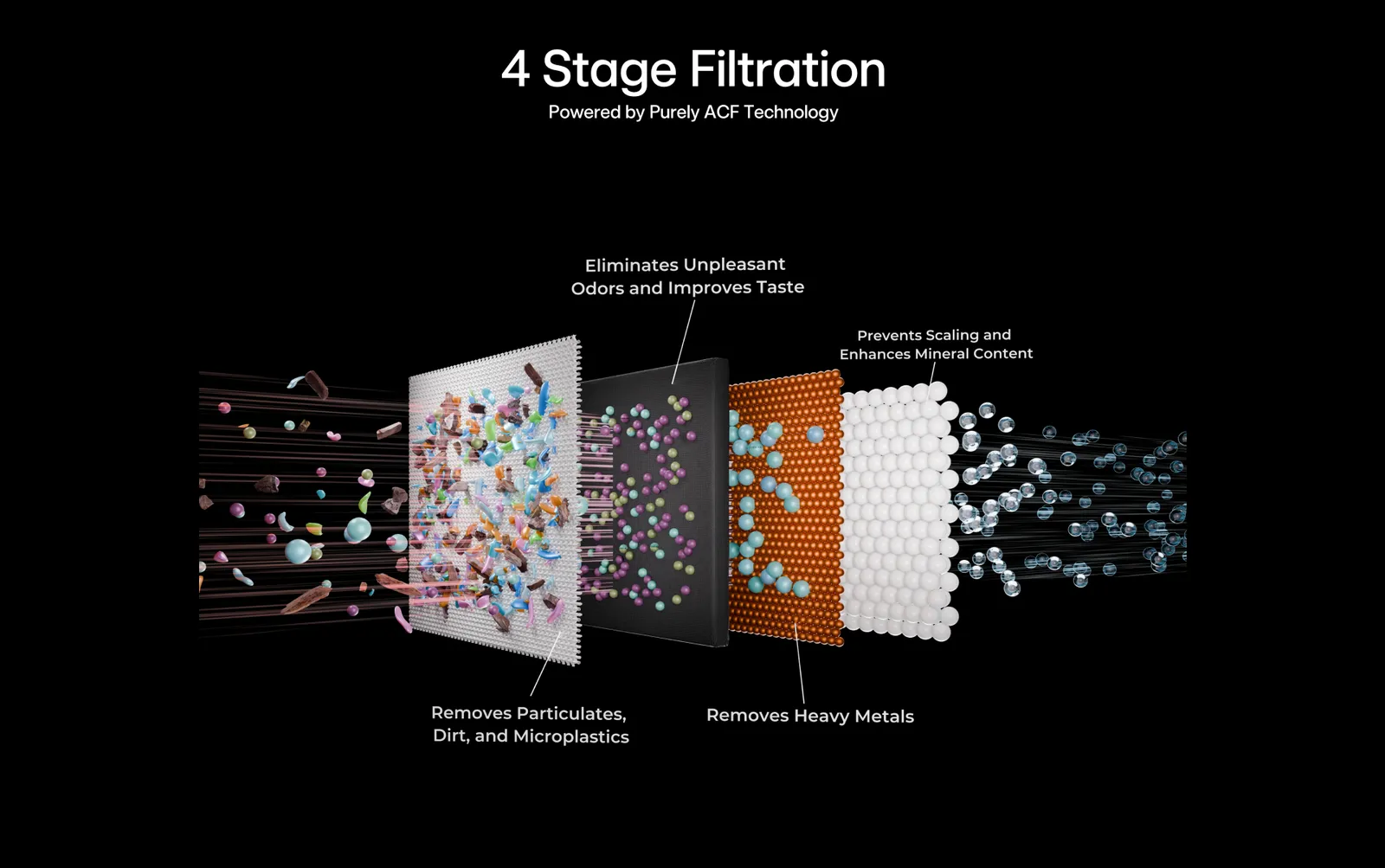
Stage 1: PP5UM catches the grit
The name sounds like a robot, but it's simple. "PP" is polypropylene, the tough plastic used in yogurt tubs. "5UM" means 5 microns. That's the size of the smallest speck this layer is built to stop.
How small is that? A human hair is about 70 microns wide. So Stage 1 stops specks about 14 times thinner than a hair. Think rust flakes from old pipes, sand and silt.
It also protects everything behind it. With the grit gone, the finer layers can focus on the things you can't see.
Stage 2: Nanofiber+™ does the heavy lifting
This is the heart of the P1. Nanofiber+™ is activated carbon fibre made from two plants: coconut and cotton.
Carbon doesn't strain water like a sieve. It works more like Velcro. As water flows past, chlorine and other chemicals stick to the carbon's surface and stay there. So the more surface a carbon has, the more it can hold.
That's where fibre shines. Nanofiber+™ has about 1,500 square metres of surface in every gram. Regular activated carbon has about 800. Picture it this way. One gram weighs about as much as a paper clip. Inside that gram is a surface about the size of an NHL rink.
Shape matters too. Most filters use loose carbon grains or a hard pressed block. Nanofiber+™ is a web of fine strands, so water spreads out and touches more of the carbon. One study found carbon fibres worked significantly better than grains for speed and selectivity. The open web is also why the P1 is designed to keep your tap running strong without a bulky housing. We explain that in our guide to choosing an under sink water filter.
Then there's the acid wash. Plain carbon is great with chlorine, but it isn't naturally strong with metals like lead. Washing the fibres in acid changes their surface. It leaves behind oxygen-rich spots that carry a negative charge. Lead in water carries a positive charge. Opposites attract. Researchers have shown that adding these oxygen spots to coconut carbon boosts how much lead it can hold.
SGS, an independent lab, tested the whole cartridge. The P1 cut:
- Lead by 98.9% at 10,000 litres
- Chlorine by 98.1% at 10,000 litres
- Chloroform, a chlorine byproduct, by 96.9% at 10,000 litres
- Fine particles from 0.5 to 1 micron, the size class used for microplastic claims, by more than 99%
You can check every number in the P1 performance data sheet.
Stage 3: Silvercore™ guards the quiet hours
Here's a catch with every carbon filter. Chlorine is what keeps bacteria from growing in city water. Carbon takes the chlorine out. So the damp carbon inside a filter can turn into a cozy spot for bacteria, mostly when water sits still. Overnight. During a work day. Over a week at the cottage.
This isn't just a theory. In one study of home carbon filters, bacteria counts in the filtered water climbed for three weeks and stayed high.
Silver is the classic fix. In the P1, it's infused right into the Stage 2 fibres. Its job is to slow bacteria from multiplying inside the cartridge when your tap is off.
One thing to be clear on. Silver isn't there to disinfect your water. Your city already does that. In the same study, filters with silver held back coliform bacteria, but not all bacteria growth. Silvercore™ is there to help keep the filter itself fresh between uses. After a long trip, it's still smart to run the tap for a minute before you fill a glass.
Stage 4: Activated alumina goes after what carbon misses
Carbon is best with chlorine and carbon-based chemicals. But some things in water aren't carbon-based at all. Fluoride and arsenic are two examples, and carbon alone does little to reduce them.
That's the job of activated alumina. It's a hard, porous mineral full of tiny holes that hold on to these leftovers. It isn't a new trick. Health Canada names activated alumina among the technologies that can reduce fluoride and remove arsenic in drinking water.
Two honest notes. First, our published SGS results don't include fluoride or arsenic numbers yet, so we won't quote a percentage here. Second, you may not have much of either to begin with. Montreal doesn't add fluoride to its water, as we explain in our guide to fluoride in water. And Health Canada says arsenic in Canadian drinking water is generally below 0.005 mg/L. Think of Stage 4 as a backstop, not the headline.
How the P1 compares with pitcher and fridge filters
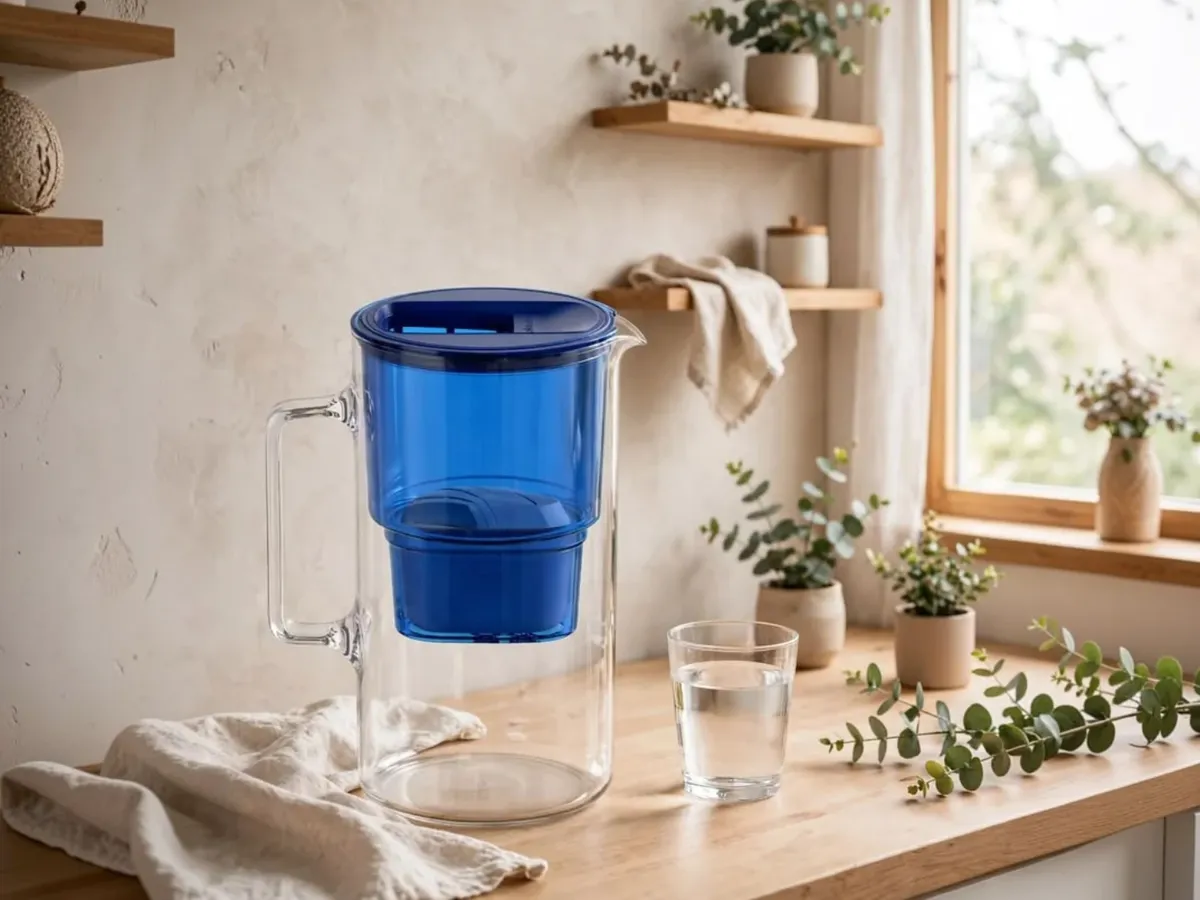
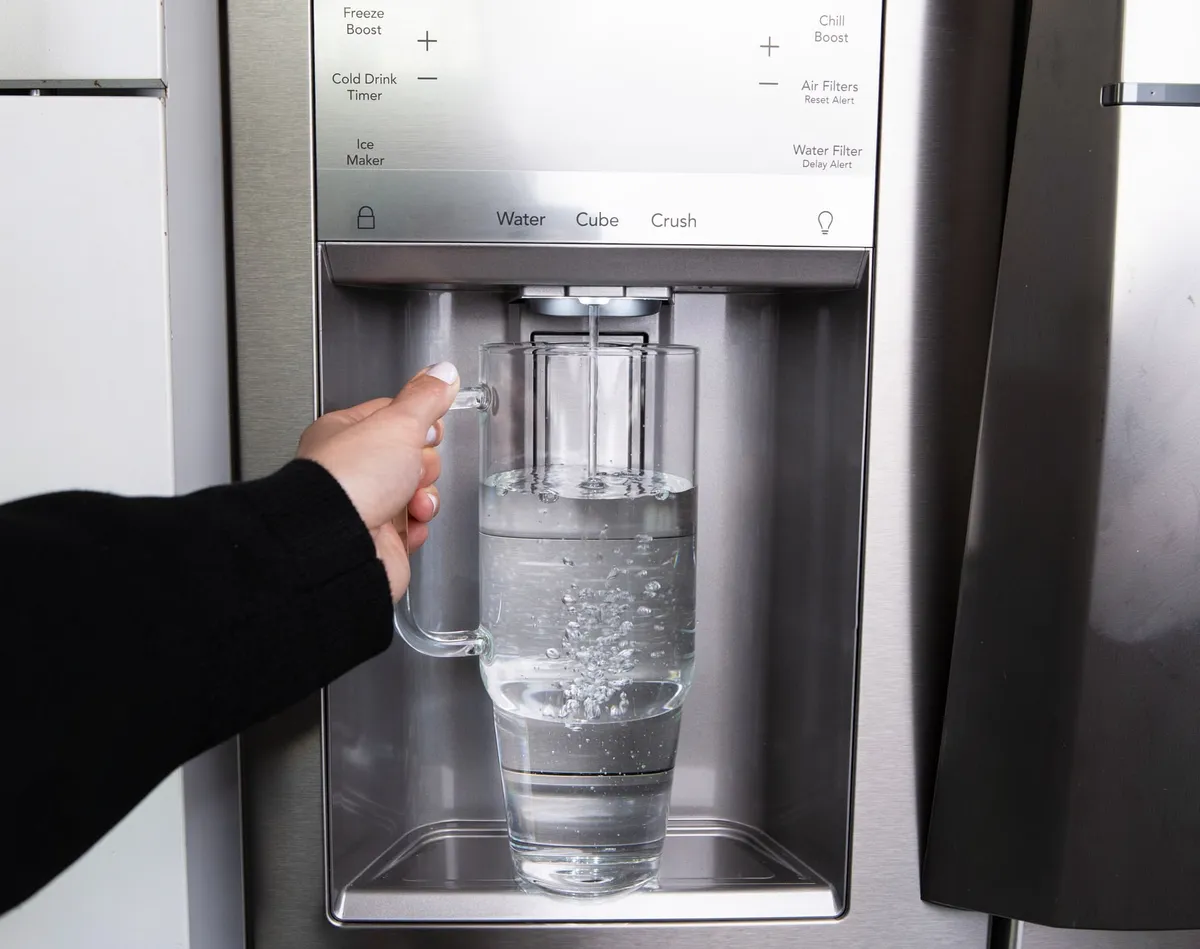
Most pitcher and fridge filters use generic activated carbon: loose grains or a small pressed block. It has one main job, which is making water taste better. Here's the side by side.
| What's in the water | Purely P1 with Nanofiber+™ | Generic activated carbon (standard pitcher and basic fridge filters) |
|---|---|---|
| Chlorine taste and smell | 98.1% less at 10,000 L | Yes. It's what they're built for |
| Lead | 98.9% less at 10,000 L | Often not covered. Check your cartridge |
| Chloroform (a chlorine byproduct) | 96.9% less at 10,000 L | Not listed for a standard pitcher filter |
| Fine particles (0.5 to 1 micron) | More than 99% less | Usually no claim |
| Fluoride and arsenic | Targeted by Stage 4. No published test number yet | Not what carbon is built for |
| Cartridge life | Up to 2 years or 21,346 L | 151 L (pitcher) or about 757 L (fridge) |
The P1 numbers come from SGS testing. The other column comes from what the makers publish.
Brita says its standard pitcher filter reduces chlorine taste and odour, copper, mercury and cadmium. It's rated for 151 litres. Lead isn't on that list. A typical name-brand fridge cartridge is rated for about 757 litres, or six months.
To be fair, some upgraded pitcher filters and name-brand fridge cartridges do cover lead. So check the label on yours. We go deeper in our guides to the water pitcher filter and the fridge water filter.
It keeps working as the litres add up
Every carbon filter fades as it fills up. The real question is how fast.
The bar is lower than you'd think. To pass NSF/ANSI 42, the taste and odour standard, a filter only has to cut chlorine by 50%. Our guide to good water filters explains how these standards work.
Now look at the P1's chlorine results from SGS:
- 98.1% at 10,000 litres
- 93.8% at 20,000 litres
- 90.3% at 40,000 litres
To filter 40,000 litres with standard pitcher filters, you'd need about 265 of them. One P1 cartridge was still cutting chlorine by 90% at that point.
Why does it hold up? It goes back to Stage 2. More surface means more room before the carbon fills up. And the fibre web spreads water evenly, so the whole cartridge gets used, not just one worn path.
A fair warning, though. That 40,000 litre run was a lab stress test for chlorine only. Other things, like chloroform, wear a filter out sooner. So follow the replacement schedule: up to 2 years or 21,346 litres, whichever comes first. The Purely app tracks your use and tells you when it's time.
The short version
- Stage 1 catches the grit.
- Stage 2 handles chlorine, lead and more.
- Stage 3 helps keep the cartridge fresh between uses.
- Stage 4 targets what carbon misses.
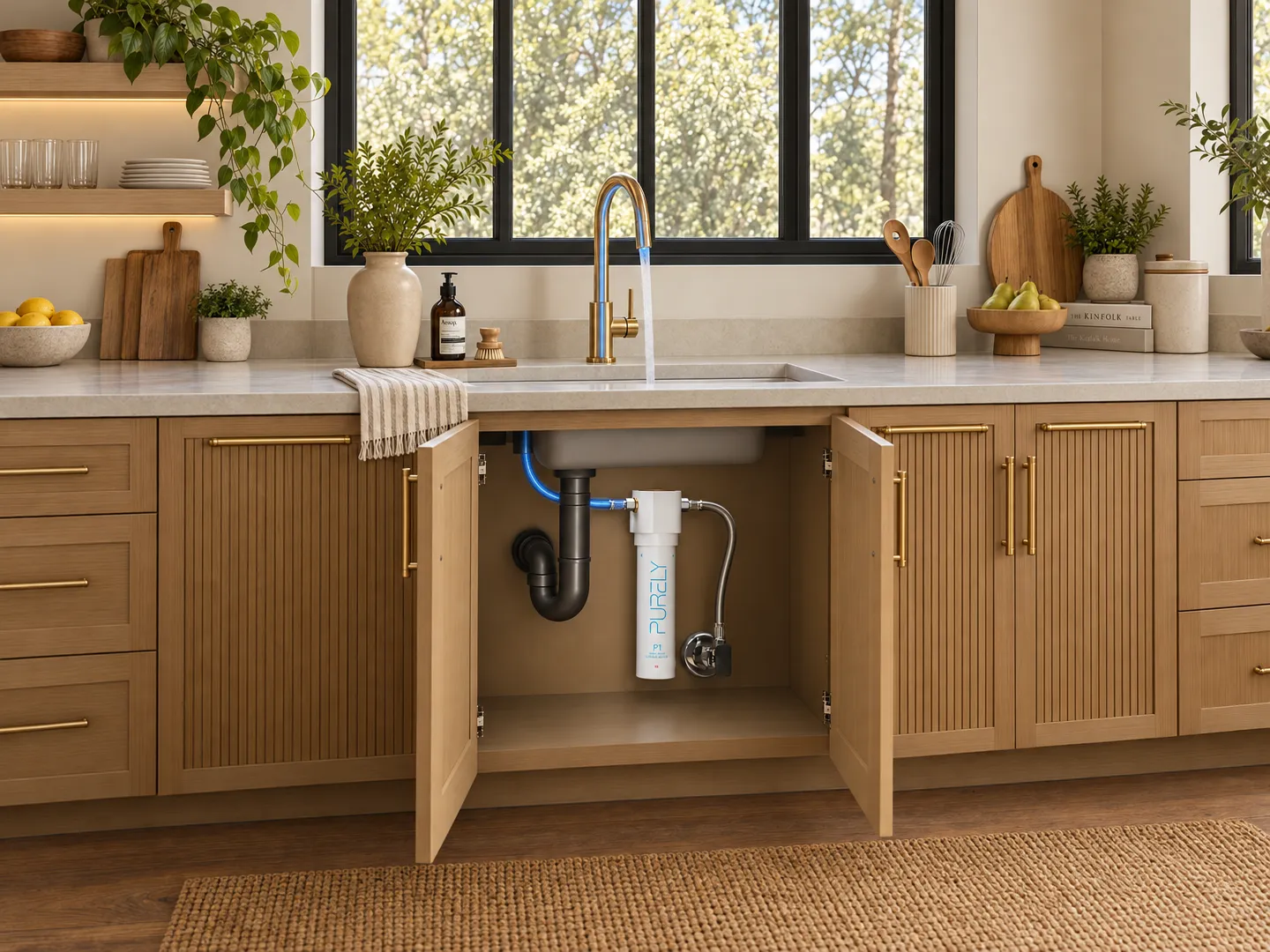
All four sit in one cartridge that installs under your sink in about 10 minutes, with no plumber. It's designed to leave natural minerals like calcium and magnesium in your water. The P1 is $260, with a 30-day money-back guarantee and a 5-year warranty.
Four stages, one cartridge, and the test results to back it up. Explore the P1 Under-Sink →
Not sure what's in your water? Look up your area in our water report →
Frequently asked questions
What do the stages in a water filter do?
Each stage is a layer with one job. Usually one catches particles and one uses carbon for chlorine and chemicals. Some filters add special media for things carbon misses.
Is a filter with more stages better?
Not on its own. A stage only helps if it targets something in your water and has test results behind it. Four proven stages beat seven vague ones.
Does the P1 remove fluoride?
Stage 4 uses activated alumina, a media Health Canada names for reducing fluoride. We haven't published a tested fluoride number for the P1 yet, so we don't quote one. Keep in mind that Montreal doesn't add fluoride to its water.
Why is there silver in a water filter?
Carbon removes chlorine, so bacteria can grow in a damp filter between uses. Silver helps slow that growth inside the cartridge. It isn't meant to disinfect your water.
How long does a P1 cartridge last?
Up to 2 years or 21,346 litres, whichever comes first. It depends on your household and your water. The Purely app tracks it for you.
Does the P1 take minerals out of the water?
It's designed not to. Unlike reverse osmosis, the P1 leaves natural minerals like calcium and magnesium in your water.
Is the P1 NSF certified?
Not yet. SGS, an independent lab, has tested it against the NSF/ANSI 42 and 53 requirements. Full NSF certification is in progress.
Sources
- Purely, P1 Performance Data Sheet
- Purely, P1 Under-Sink product page
- Purely, Nanofiber+™
- US EPA, Particulate Matter (PM) Basics
- OSTI, The adsorption onto fibrous activated carbon: applications to water and air treatments
- Environmental Science and Pollution Research, Enhanced adsorption of Pb2+ by the oxygen-containing functional groups enriched activated carbon
- Tobin, Smith and Lindsay, Effects of activated carbon and bacteriostatic filters on microbiological quality of drinking water
- Health Canada, Guideline Technical Document: Fluoride
- Health Canada, Guideline Technical Document: Arsenic, treatment
- Health Canada, Guideline Technical Document: Arsenic, rationale
- Brita Canada, Replacement filters for water pitchers
- Maytag, EveryDrop refrigerator water filter 1